Month: July 2011

  • Stevens Lakes


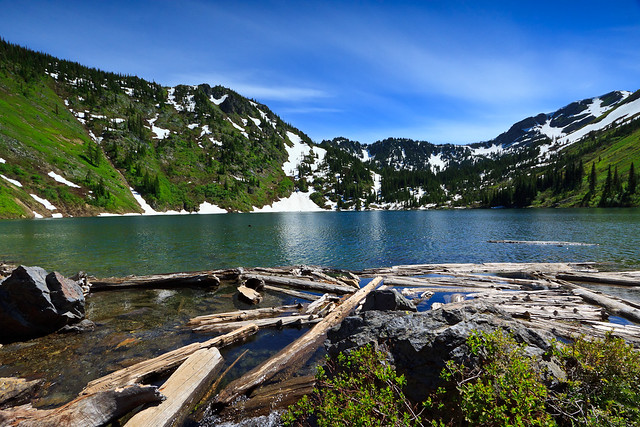
    Lower Stevens Lake
    Lower Stevens Lake


    The hike to Stevens Lakes itsn’t particularly hard, but it’s no walk in the park either. It’s about 2.5 miles and 1700 feet of vertical gain to the upper lake on a well-used and well-mantained trail. It starts off relatively steep and continues to climb steadily for the next mile before levelling out briefly as the trail emerges from a beautiful forest into an open basin surrounded by walls several hundred feet high. Just atop the headwall, 350 feet up, is the first lake, and Willow Creek drains from Lower Stevens Lake to drop over this ledge with a series of amazing waterfalls. It is at the bottom of this drop that the trail crosses the creek to start the mighty ascent and final approach to the lake. The old trail used to route you straight up the incline, but a new trail routes you along a series of switchbacks across a talus field, but on this July day, we were crossing a fairly significant snow field. As the trail came back with the old route, the final switchbacks were also snow covered, but the snow was soft and kicking steps was quite easy. We passed a view of the upper waterfall, a beautiful 30-40 ft. drop, before levelling out atop the wall. It was not long before the lake came into view along with a seriese of campsites along the northern shore.

    I was surprised to see so much snow at sub-6000 foot elevations this late into July, but the upper lake, only a few hundred feet higher, was still mostly frozen over. There was a warm sun, cool breeze, and not a sound from the developed world despite the close proximity to a major interstate. We had only hiked in a little over 2 miles at this point, but it felt like the middle of the wilderness. I was also surprised at how pristine the forest was on this hike. The land closer to the interstate had been logged, and is still being used for timber harvesting, yet the Stevens Lake trail saw none of it. Along with the snow, it was still early spring up there. The Glacier Lillies, Trillium, and Forget-me-nots were in bloom all over the place, and on the lower sections of the trail, I finally saw some Beargrass in full bloom.

    Stevens Lakes are a popular camping spot, and it’s not hard to see why. It’s so relaxing with beautiful scenery but not a huge effort to get there. On this day, there were at least 3 groups camping for the night. There are also a handful of sites by the upper lake, but they were stilI  burried under a couple feet of snow. In a few weeks, I may have to return and continue my hike up to Stevens Peak, an easy bushwhack to the ridge and a jaunt to the summit. I braved the snow and made it up to the upper lake for a few shots before turning back and descending to the car.

    We finished the day with a dinner in Wallace.

    There are many of these alpine lakes all over the mountains of the west. Many of them require long and strenuous hikes, but the reward is often worth it. But for families and non-hikers, the trip can be intimidating. Some of these lakes are accessible by car, but when you drive into one of these basins, you lose some of the magic and serenity. Some of the hikes are easy and require a difficult drive over primitive roads to start your hike in the high country. What makes Stevens Lakes so appealing is that it is easy to get to, right off of I-90, and the hike can be made for all levels. If you’re in shape, you can easily make it to the lakes in an hour and then continue up the ridges. If you’re slower, you can take all the time you want because it’s only 2 miles in. It’s a great way to spend a summer day and get to some great scenery.

    View the Photo Album from this hike.


    View Stevens Lakes Hike in a larger map
     

  • 4th of July

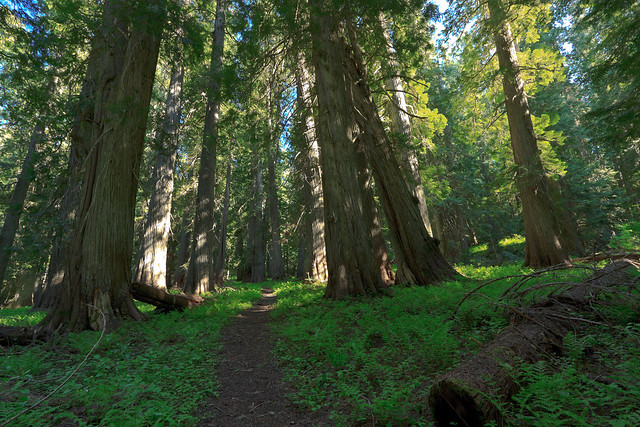
    Hobo Cedar Grove

    The celebration of our nation’s independence is a custom dating back all the way to the day the Continental Congress approved and signed the Declaration of Independence. The use of fireworks to celebrate the momentous and historic occasion also dates back to that time. As John Adams wrote to his wife:

    “The second day of July, 1776, will be the most memorable epoch in the history of America. I am apt to believe that it will be celebrated by succeeding generations as the great anniversary festival. It ought to be commemorated as the day of deliverance, by solemn acts of devotion to God Almighty. It ought to be solemnized with pomp and parade, with shows, games, sports, guns, bells, bonfires, and illuminations, from one end of this continent to the other, from this time forward forever more.”

    Adams’ reference to the second of July marks the day that the Continental Congress approved a measure to declare independence. The official document, was signed two days later. Regardless, the founding fathers had visions that for years to come, that day would be memorialized with great celebration including the beloved fireworks display we have come to enjoy.

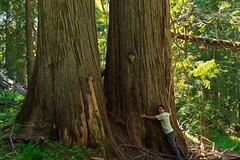
    But while most people were celebrating America by blowing a part of it up, I chose a much more solemn way to pay tribute to this great country. We often remember our historical heritage during these days, but we sometimes forget about our natural heritage. On this day, I visited a grove of trees so old, they were standing tall long before the European settlers ever set foot upon the continent. These trees are a testament to the persistence of nature to thrive against the rugged challenges thrown at it. These trees have survived centuries of fire, drought, snow, and winds. And after all of the beatings, the trees still stand only to be taken down in mere hours by the hand of man.

    Among the GiantsThere are few old-growth virgin timber stands left in the United States. When the settlers arrived, they quickly chopped down the forests for farm land, wood, and security. After all, much of Europe’s forests had already been decimated before the Americas were colonized, and the wilderness was a scary and dangerous place. But it also provided raw materials and natural resources with which to create new products and amass wealth. When the West was finally settled, the forests, with their big trees, were quickly taken advantage of. Fortunately, a few of the industrialists and businessmen who were responsible for the massive destruction of the landscape also recognized the importance of preserving some of it for generations to come. And for whatever reason, whether it be inaccessibility or the sheer awe struck by the people who saw them, some of these stands of forest were spared the wrath of the timber and mining industries and preserved for us to see today.

    My 4th of July trip took me to the Hobo Cedar Grove and Botanical Area near the town of Clarkia, Idaho. The trees here aren’t the largest, but the forest is impressive. The one-mile walk through this patch of old-growth forest is enough to make you forget that you drove through a clear-cut to get there. At 4500 feet, it’s a great place to beat the heat. Temperatures on the Palouse were over 80 at mid-day, yet when I pulled into the parking area, the air was a pleasant 72. There is a picnic area and restroom at the trailhead, and a one-mile loop through some of the most beautiful forest I have ever seen. There is a shorter interpretive nature trail as well. The trail is well-maintained, though there were several downed trees across the path at this time. I suspect the maintenance occurs later in the summer. The drive to the grove is very scenic as well. From Clarkia, you drive along Merry Creek and then ascend into the mountains. While you do drive through a section of clear-cut forest, the clear-cut does open up views of the mountains to the west.

    There are lots of other things to do in the area as well. You can continue driving to the St. Joe River, or take another turn back in Clarkia and head up to Freezeout Saddle. As of a few weeks ago, the road was drivable almost to the Grandfather Mountain trailhead. I imagine that if the road isn’t clear now, it will be in a week or two. Back down in Clarkia, you can search for fossils at the Fossil Bowl or head to the Emerald Creek Garnet Area, one of only two places in the world where you can find star garnets.

    I am thankful that somebody had the foresight to preserve and protect the awesome beauty and splendor of our natural heritage, leaving us with great places for recreation and study. Oh, and in case you were wondering, yes, I did partake in the explosive celebrations later in the evening.

    Fireworks Fireworks

  • Shoot for the Stars

    Stargazing I
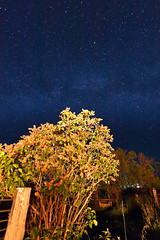
    The night sky from my yard.

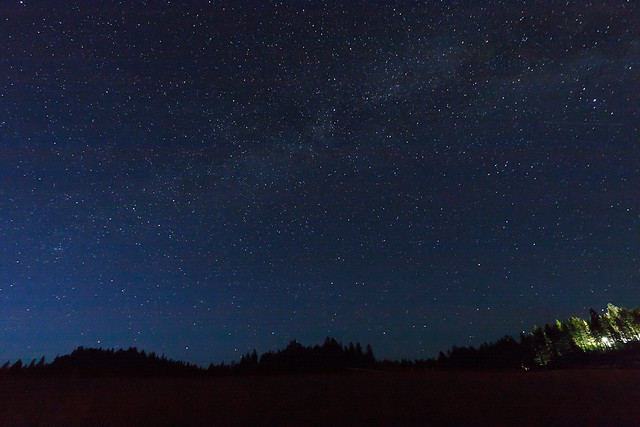
    Last night, I had some folks over from the photo club for a little get together and fun. We grilled burgers, sat around the fire, and played with our cameras. We were mostly interested in shooting the night sky. I’ve shot the stars before, but last night might be my most successful attempt yet.

    Stargazing IIShooting the night sky is rather difficult, but it can be quite rewarding. One can end up with an image with more stars in it than the eye can see. The problem is that stars are not very bright, so to capture enough light, you have to use a long shutter speed. Therein lies another problem: stars move in the sky. One solution is to expose for a very long time and capture the star trails. With digital photography, this is a somewhat difficult approach. For one, the sensor is using battery power to capture the image. So the longer the exposure, the more battery gets used. An all-night exposure is nearly impossible. Using film, you can open the shutter forever and not draw any power.

    The other option is the “short” exposure, and by short, I mean keeping it to 30 seconds or less. Even at 30 seconds, we begin to notice movement in the stars, but it may not be so much to detract from the image. The images on this post were taken at 30 seconds, but you only see star movement if we blow the image up pretty big. There one last trade-off to consider. Do you want a night sky with lots of stars and milky way detail, or do you want your image to be crisp and sharp all around? To get lots of light, you need a large aperture, f/2.8 or larger. But while large apertures let in lots of light, they’re also difficult to focus and lenses aren’t usually their sharpest at their widest aperture. Stopping down can get you a crisper image, but you’ll only pick up the brightest stars. But with practice and lots of patience, you can have your cake and eat it too.