Palouse Falls

There seems to be a trend among people that when you live in a certain area, you tend to take for granted your proximity to tourist attractions and not visit them. Local attractions aren’t really a priority because they’re always there, so you can always visit them later. Well, later can turn into years. In this case, three years. I’ve gone three years without having visited Palouse Falls despite it being a major attraction in the area. To be fair, Palouse Falls isn’t really on the Palouse, but it’s an almost 200 foot sheer drop along the Palouse River in central Washington. It takes about two hours to get there from Moscow, and there’s not a whole lot else around it. Thus, it hadn’t been high on my priorities. Nevertheless, I’ve always wanted to see the falls, and I made an excuse to take Erin to go see them this weekend. To make the drive worth the effort, I planned to grab as many geocaches along the way as I could. I think I did pretty well: thirteen in one day.

So, here’s what makes Palouse Falls so special:
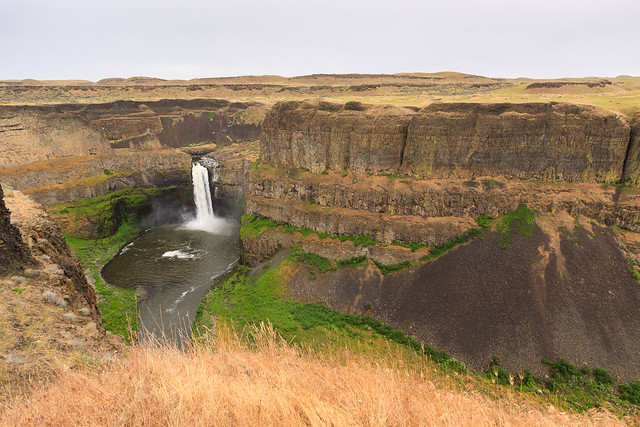
Palouse Falls - farther back

That waterfall is nearly 200 feet tall, 198 feet to be precise. If that’s not impressive enough, the falls are less than half the total depth of the canyon. Needless to say, this basalt gorge is pretty neat. The sheer canyon cliffs remind me of the sandstone canyons of southern Utah, at least in shape. It’s a very cliche western scenery. Somehow, there are trails that lead closer to the falls and even to the bottom, but with my leg still healing, I wasn’t about to risk an injury. So, we stayed in the safety of the canyon rim.

When I said that Palouse Falls was not on the Palouse, what I meant was that it’s not in the eco-region called the Palouse. The Palouse was a prairie, much of which has been raised for agriculture. It’s a region of lush rolling hills, wheat, canola, and lentil farms, and general awesomeness that looks much like this:
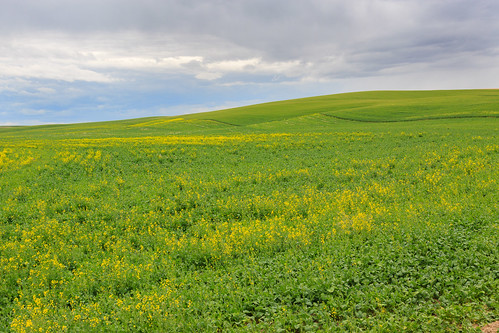
The Palouse

In contrast, there’s a point heading west where the farms end and the scrubby rangeland begins. It’s almost a desert out there with the main flora consisting of sagebrush and fewer grasses. It reminds me of southern Idaho, which is also a sagebrush steppe semi-desert with canyons cutting through the bassalt. I suppose that’s the real attraction. The landscape is beautiful. The towns are not. The nearest town to the falls is Washtucna. There’s a convenience store and a country dive bar. The rest of town is boarded up.

Despite its proximity to almost nothing, the park at the falls is pretty nice. There’s a well-kept lawn for picnics and camping and the trails are well maintained and easy to follow. I thought that the rainy weather would hamper my photography expedition, but I think I got a few nice shots with the wet camera. I’d certainly like to return in better weather, maybe even camp out to get some sunset and sunrise shots at the falls. I’d certainly like to hike down into the canyon once my leg gets better.
Palouse Falls Canyon View

Similar Posts

  • Moscow Mountain Snowshoe

    Saturday, January 14, 2017 It’s not often that I get out to hike these days. But we’ve had a fantastic winter so far, and after a week of insanely cold temperatures and clear weather, I just had to get out and take advantage before the warm weather and rains took over. I’ve always wanted to hike to the lookout on East Moscow Mountain in the winter, but on every attempt, I was thwarted with people who just couldn’t make it all the way up. So on Saturday, I had a nice sunny day and some time to go for a…

  • Snowshoeing Moose Creek

    Last week, winter returned to the Palouse. We got about six inches of snow in Deary, most of which was still around over the weekend. On Sunday, I joined a group of students and post-docs for a snowshoeing trip to Moose Creek. Although it was a foggy and overcast day, we had a great time. I’m always amazed at how much more snow Moose Creek gets, despite its close proximity to home. I estimate the snow was about a foot deep, which is plenty for snowshoeing. We ended up hiking just under 2 miles in before turning around and heading…

  • |

    Evo-WIBO weekend recap

    This past weekend, I was in Port Townsend, WA for the bi-annual Evo-WIBO meeting. Evo-WIBO is a small, regional gathering of someo of the biggest names in evolutionary biology in the Pacific northwest. Its only a day and a half long and very informal. Yet, because of its size and intimacy, I got more out of this meeting than I did when I presented at the much larger SICB meeting in January. I met and hung out with more people than I would have, which made it a lot of fun. The only downside is that it was so nice…

  • Oregon Butte: The Successful Failure

    View Oregon Butte – 5/26-27/2012 in a larger map Things don’t always go according to plan. Along the journey, you discover new interests or find obstacles that end up providing you with a totally different experience than originally expected. This lesson was hard hit this weekend as we attempted a backpacking trip in the Blue Mountains of southeastern Washington. The trip was a success, but certainly not what I had expected. It’s really a lesson in not getting enough information ahead of time. On paper, it looked like the perfect trip. It’s a 16-mile loop up Panjab Creek to the…

  • Turnbull National Wildlife Refuge

    I had to go to Spokane for a follow-up appointment with the orthopedic surgeon, and it happened to be a nice day, so I suggested that while we were up there, we should go to the Turnbull National Wildlife Refuge and spend some time outdoors. I’ve known the refuge was there and have always wanted to check it out, but I’ve always put it off. Since it has some handicap accessible trails, this was a good time to check it out. Wildlife refuges are different than your typical national forest or national park lands. Their primary goal is to protect…

  • East Moscow Mountain

    [map style=”width: auto; height:400px; margin:20px 0px 20px 0px; border: 1px solid black;” gpx=”http://www.mineral2.com/wp-content/uploads/Moscow Mountain Hike.GPX”] I had heard about the big trees on Moscow Mountain, but I had yet to experience them for myself. I first drove the road along the ridge back in 2010, the year I moved to Idaho. Back then, I passed some fairly large trees along the side of the road, and I assumed those were the trees everyone was talking about. But as I did some more research, I found that there really was a stand of old grown timber remaining on the north side of…