Month: October 2012

  • Fall Foliage

    Fall Foliage

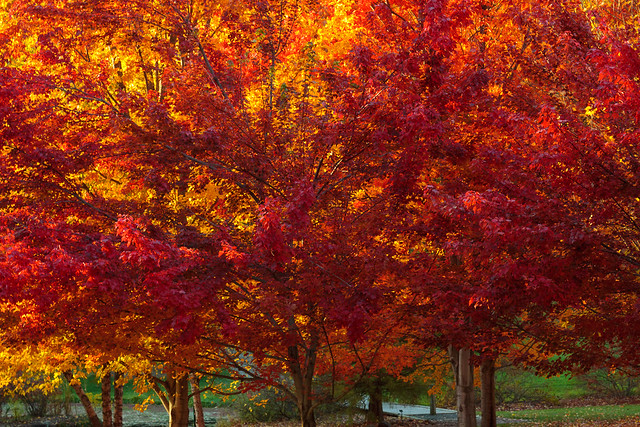
    I’ve been spending a lot of time finishing up my dissertation proposal, which is due in a little over a week, and that has kept me from taking time to enjoy the outdoors. We got some considerable rain over the past weekend which lead to some dramatic skies and really clear views on Monday and Tuesday, but I just wasn’t able to take advantage of the nice conditions. I did get out for a little bit yesterday afternoon to check out the fall foliage in the arboretum on campus.

    In Idaho, we don’t see very much fall color. There are a few shrubs and trees that turn this time of year, but for the most part, the grasses become even more brown, and most of the deciduous plants skip the color part altogether. The key to great color is a cold and wet climate. We have the cold during the winter, and even the wet in the spring and early summer, but it gets too hot and dry to sustain wild populations of maples, birches, and aspen. What we get are some stands of colorful trees here and there rather than large vasts of colorful forests that carpet the landscapes of Maine, New Hampshire, and Vermont. But there are some places where these trees have been planted and maintained in an artificial setting. The university’s campus is one place to find such color.

    You won’t find much color out of the giant Norway Maples on the front lawn, but the Sugar Maples, Black Maples, and Red Maples along with a few other species produce spectacular displays. Some of the best fall trees are located right behind the life science building, but another great stand is found in the arboretum. These trees, native to northeastern North America, are sustained by constant watering and landscape maintenance throughout the dry summer. It’s the best we can do in this part of the country to reproduce the kind of fall seen in northern New England and southern Canada.

    The fall colors that we know and love are a result of pigments produced by the plants year round. But during the growing season, they are masked by the abundance of chlorophyll produced. As a result, these pigments aren’t seen during the spring and summer. But as the season comes to and end and temperatures drop, the plant stops producing pigments for photosynthesis. The chlorophylls are the first to break down, and when they do, we are left with the xanthophylls and carotenoids which are yellow and red. These pigments aid the plant in photosynthesis by absorbing wavelengths missed by the chlorophylls. Each species has a different compositional make-up of pigments such that when the chlorophyll breaks down, we see different colors in each plant.

    Click on the image above to see some more images from my walk in the arboretum.
  • Aurora

    Aurora
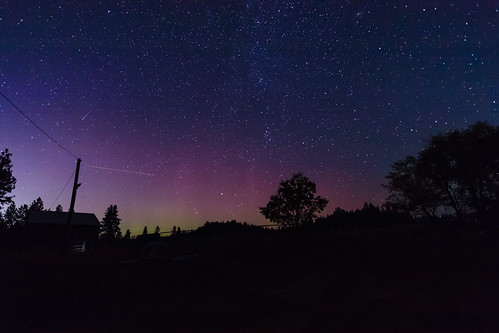
    A test shot from early on in the night. Notice the two meteors captured in this frame. Apparently, I also caught the end of a major meteor shower.


    This story begins Friday night when I learned that a large coronal mass ejection (CME) sent a burst of solar radiation from the sun headed toward Earth. It was predicted to intercept our atmosphere on the evening of the 8th, producing auroral activity in the high latitudes. Given the size of this solar storm, as described by spaceweather.com, I was a bit suspicious that the auroras migh be big enough to see all the way down here in northern Idaho. So, I kept a watch looking for evidence of such activity.

    On the evening of the 8th, I checked Spaceweather and confirmed that there had been some strong auroral activity, and that it had been seen earlier that morning as far south as Utah. I rushed outside and didn’t see much. I set up the camera for a test shot and picked up some faint auroral glow, but it seemed to be far in the distance and nothing worth getting excited over. I was beginning to think that I had missed the aurora and should have stayed up the night before. Throuout the evening, I would periodically go out side and take a test shot of the northern sky, and while the glow got brighter, it never reached the level that it had during previous auroras. So while I went out for the last test shot at 11:30, Erin had gone to bed. I stayed up in an attempt to finish grading exams, but ended up nodding off in the middle. I admitted defeat and around midnight, decided to quit and go to bed.

    Dancing Light
    Curtains of light filled the sky during the most intense flare I had seen.


    Before turning in for the night, I stepped out to check the sky once more. I figured, it wouldn’t hurt. Of course, I wasn’t expecting to see columns of light beaming high into the night sky. The aurora had really flared up. So I grabbed my jacket and my camera and decided to drive a few miles south where there were some flat fields and a clearer view of the sky. I was mostly interested in photographing the aurora with a different foreground than the usual barn and trees outside the house. When I pulled off the road and set up the camera, I got something I wasn’t expecting at all. There were full-fledged curtains streaking from the north across the sky overhead, and they could be seen clearly with the naked eye. This was too much to bear. I quickly set up the camera and snapped the first shot. Thankfully, there was cell service where I was and I was able to call Erin and get her out of bed for this one. I also called Colleen, who promptly got in her car and headed out to our place from Moscow.

    Meanwhile, I stood out in the field for a good 20 or 30 minutes marvelling at the dancing curtains while snapping away. At one point, I noticed a flash in the sky. I thought maybe someone had come out with a spotlight, but there was no other human activity to be found. It happened again, and again, and soon I noticed that the light was radiating from the north and travelling toward me in waves. The activity persisted for a good 20 minutes and then subsided. At that point, the cold was getting to me, and I decided to head home rather than wait for Erin and Colleen to come out.

    End of the Show
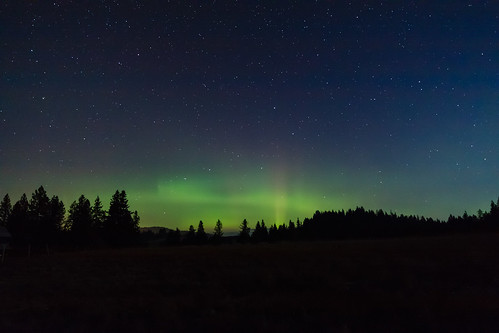
    The last harrumph before fading away for the night. It was a much more quiet flare, but still beautiful.


    The activity had subsided for a while, but I kept an eye on the reports from spaceweather.com. We went out again a little after 1:00 to see if the activity had returned, and indeed, the band across the sky had gotten brighter with some faint pillars streaking upward. Rather than drive back out to higher ground, we went into the field behind the house to see what was happening. The aurora certainly wasn’t as big as it was earlier, but it had gotten bright green. We waited to see if it would flare up some more, but it never seemed to get any bigger. So, by 1:30, we all decided to call it a night. Erin and I finally went to bed by 2:00, and after one last look at the sky, it seemed that the glow had faded out. Maybe the activity peaked again in the early hours of the morning, but I had already seen something good. After all, I had to be up in 3 hours to get ready for work.

    While the lack of sleep had taken its toll on me, it was totally worth it to witness this totally awesome spectacle of the universe. A geomagnetic storm this strong doesn’t happen very often, and when it does, I’ll be sure to be outside capturing it.