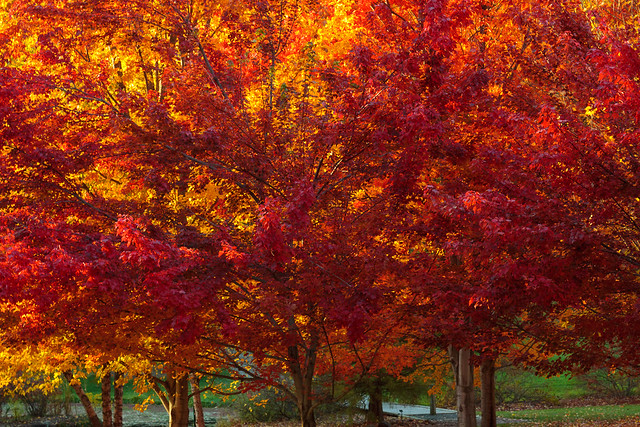
Fall Foliage

Fall Foliage

I’ve been spending a lot of time finishing up my dissertation proposal, which is due in a little over a week, and that has kept me from taking time to enjoy the outdoors. We got some considerable rain over the past weekend which lead to some dramatic skies and really clear views on Monday and Tuesday, but I just wasn’t able to take advantage of the nice conditions. I did get out for a little bit yesterday afternoon to check out the fall foliage in the arboretum on campus.

In Idaho, we don’t see very much fall color. There are a few shrubs and trees that turn this time of year, but for the most part, the grasses become even more brown, and most of the deciduous plants skip the color part altogether. The key to great color is a cold and wet climate. We have the cold during the winter, and even the wet in the spring and early summer, but it gets too hot and dry to sustain wild populations of maples, birches, and aspen. What we get are some stands of colorful trees here and there rather than large vasts of colorful forests that carpet the landscapes of Maine, New Hampshire, and Vermont. But there are some places where these trees have been planted and maintained in an artificial setting. The university’s campus is one place to find such color.

You won’t find much color out of the giant Norway Maples on the front lawn, but the Sugar Maples, Black Maples, and Red Maples along with a few other species produce spectacular displays. Some of the best fall trees are located right behind the life science building, but another great stand is found in the arboretum. These trees, native to northeastern North America, are sustained by constant watering and landscape maintenance throughout the dry summer. It’s the best we can do in this part of the country to reproduce the kind of fall seen in northern New England and southern Canada.

The fall colors that we know and love are a result of pigments produced by the plants year round. But during the growing season, they are masked by the abundance of chlorophyll produced. As a result, these pigments aren’t seen during the spring and summer. But as the season comes to and end and temperatures drop, the plant stops producing pigments for photosynthesis. The chlorophylls are the first to break down, and when they do, we are left with the xanthophylls and carotenoids which are yellow and red. These pigments aid the plant in photosynthesis by absorbing wavelengths missed by the chlorophylls. Each species has a different compositional make-up of pigments such that when the chlorophyll breaks down, we see different colors in each plant.

Click on the image above to see some more images from my walk in the arboretum.
Similar Posts

  • The Prairie in Bloom

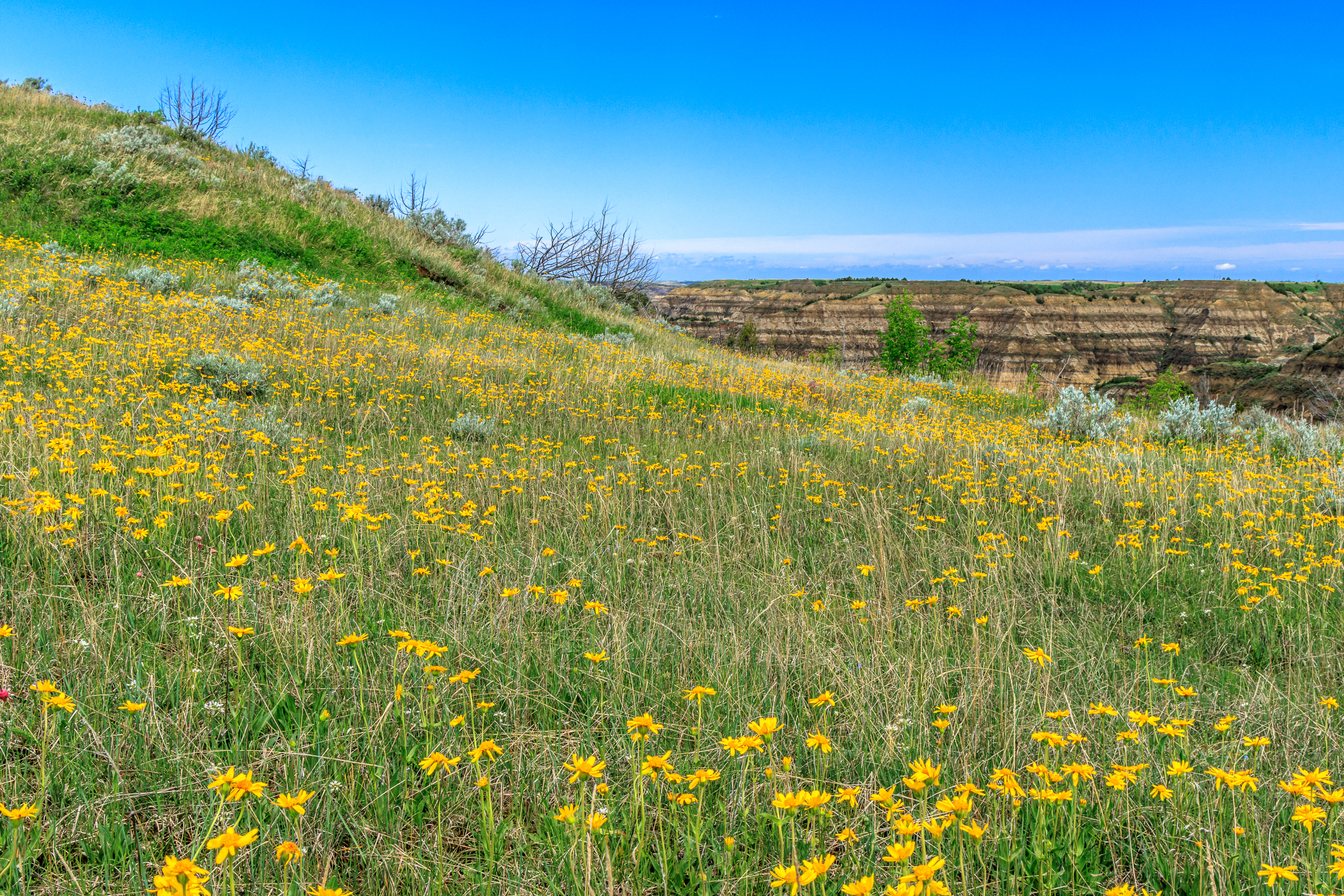
    With the school year over and nice weather upon us, I’ve had some free time to get out and explore the landscape beyond Williston. I’ve been out on the prairie twice to discover the array of early wildflowers in the grasslands. This is the time of year when I feel like I could actually enjoy this place. Unfortunately, it doesn’t last very long. It’s said that there are only two seasons on the northern plains – a very long winter, and a short summer. Spring and Fall exist, but only for a week. All year round, the wind can blow…

  • Photographing Birds on the Farm

    Fox sparrow Passerella iliaca White-crowned sparrow Zonotrichia leucophrys Northern cardinal Cardinalis cardinalis Today I took the camera out to photograph the birds. We’ve got a feeder in the front yard, but all the birds flock to the seed spilled on the ground. So I threw the dogs inside, scattered a can of seed on the ground, sat and waited. It didn’t take long for the birds to come in. Around the farm, I’ve been mostly seeing the usual winter birds: Cardinals, Chickadees, Titmice, Carolina Wren, Junco, Song Sparrow, White-throated Sparrow, and some non-feeder birds: American Crow, Raven, Black and Turkey…

  • Adventures in fast, reliable ineternet

    For the past seven years, I have been living with slow, unreliable internet. In 2004-2005, the Weis Ecology Center was on dial-up service. Camp McDowell in Alabama was also on dial-up service, shared on a wireless network. If you can remember far enough back when dial-up was the forefront of home internet technology, you might also remember how long it took for webpages to load and how it would randomly lose connection, and then the busy signals trying to reconnect. In 2006, those problems had not improved. Ferry Beach had a more reliable connection, though it was still slow. I’m…

  • Introducing Clara

      On Thursday, June 19, my 32nd birthday, Erin woke up having contractions that were 10 minutes apart, give or take a minute. This persisted through the morning. By the afternoon, the contractions had gotten closer together. We left home around 2:30 and an hour later, we were at the birth center in Moscow. Clara would have been born at the birth center with the midwife attending, but upon the final moments, we discovered she was breech. So, Erin was transferred over to the hospital where Clara came into this world ass-first at 10:47 pm. Since we’ve arrived home, life…

  • Flight Paths

    [map style=”width: auto; height:400px; margin:20px 0px 20px 0px; border: 1px solid black;” maptype=”ROADMAP” gpx=”http://www.mineral2.com/wp-content/uploads/Flights.GPX”] If you don’t already know me, I have a thing for maps and geography. It’s an absolute delight to see the landscape from the air. I’ve been bringing my GPS with me when I fly, mostly to keep track of flight progress and to identify what I’m seeing out the window. But it’s also interesting to see how the FAA routes flights. Spoiler Alert: it’s not a direct path between cities. The two tracks above show the flight path between Phoenix and Cancun in both directions….

  • Small World

    Harvest Moon, originally uploaded by Matthew Singer. Beth, one of the photo club members and employee at the Prichard Art Gallery downtown, mentioned at our last meeting that a student was in town with the current exhibit at the gallery. He didn’t know anyone and was desperate to hang out with people his own age. So we got a group together last night and hung out around the town. I thought the visiting student was an art student, but it turns out he’s actually studying conservation biology and had spent some time working environmental education. And, he’s from Maine. Well…