Month: November 2012

  • What I am thankful for

    During the weeks leading up to Thanksgiving, many people post about the things they are thankful for. I have been stewing over just how to say what it is I’m thankful for, because it’s a little bit different than most people’s ideals.

    There are two major concepts that I am thankful for. Number one is free will. Number two is an objective universe. These two ideas are not unrelated. I am thankful to know that my thoughts, my actions, and my decisions are mine, and belong to no one and nothing else. At the same time, the consequeses of my actions are mine, and only mine to bear. I am my own master, and I am under no obligation to serve anyone else.

    The thing is, the world is not a static place, and events happen outside our control that force us to make decisions that we don’t necessarily want to make. The thing is, these events aren’t inherently good or bad, we label them as good or bad depending on whether the outcome, or the effect, will be positive or negative on our lives. In fact, the same event can be both positive and negative at the same time. For example, your favorite team wins the championship game. That is good for you. You’re happy and joyous and generally in a good mood. Meanwhile, fans of the opposing team see this as bad. In reality, this event just is. It’s the outcome of a game where both teams played their best, and the winning team happened to play better on that night. We can find all sorts of causes to this effect after the fact, but we could only predict it from a known (or unknown) probability distribution.

    When things happen to us, a common response is to say “It was meant to be.” It’s meant to be a statement of comfort. It’s the less extreme verson of “God wills it so.” But what does that really mean? If it was meant to be, then the world or universe (or God) intended it to happen. Intent implies cognitive will. Can non-living entities really impose intent? Does matter and energy really care what happens to you? If it was “meant to be,” then it was determined to happen from the start, and if that’s the case, we really don’t have any free will, do we? How is that comforting to walk around knowing that something out there is out to get you?

    Instead, we can take another approach. This objective approach suggests that events in the universe are simply neutral. They have a cause and an effect, but they don’t happen specifically to target you. Instead, they are “good” or “bad” depending on what we make of them. When an earthquake hits a city, it’s not because some transient being wants to wreak havoc. It’s not to punnish people. It’s because the earth’s crust is broken into fragments that float on a semi-liquid mantle. These pieces move and crash into each other causing earthquakes and volcanoes that can set off other chains of events, and we just happen to be in the way. These events happen with some predictability as we gather data about our planet, but predictability does not translate into determination. Instead, there are tons of confounding variables that impede our ability to determine with 100% accuracy just what the oucome will be. Instead, we can predict a range of outcomes and their probabilities of occurance.

    So what is it about an earthquake that makes it effectively neutral? For one, the earth’s crust is not a conscious being making cognitive decisions. Earthquakes happen wherever tension along naturally occuring fault lines builds up. This happens somewhat randomly and can occur away from centers of human activity. When this happens and no effect is felt, it goes unnoticed by the general public and can be dismissed as a neutral event. Of course, these very same processes that cause destruction and mayhem in our lives are the processes that allow us to be alive in the first place. If the earth’s  mantle were to cool down and solidify, the climate would change, our atmosphere would collapse, and life would cease to exist.

    Of course, I’ll stop here because, as it turns out, Neil DeGrasse Tyson can explain the objectivity of the universe a lot better than I can.

    To me, this idea of a random and objective universe is a lot more comforting because I know when things happen, it’s not specifically directed toward me, and all I can do is choose to dwell in the negative or find the positive. And for that, I am thankful.

    Oh, and also for my wonderful wife.
  • Thanksgiving in Las Vegas, Part 1: The drive down

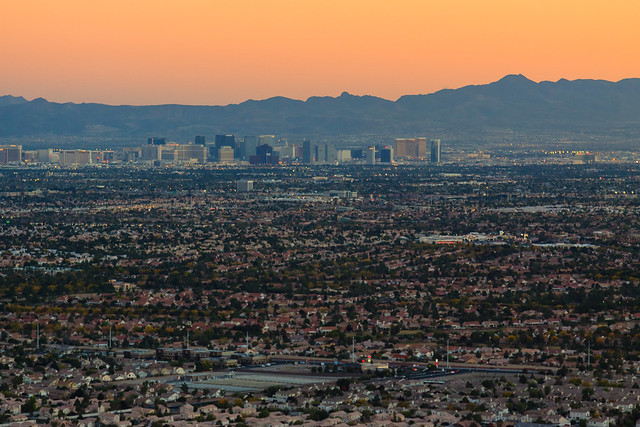
    Las Vegas from Lone Mountain

    One of my best friends from high school invited Erin and I down to Las Vegas for Thanksgiving. In fact, we were invited down last year, but we weren’t able to make it. Therefore, I decided that we’d make it work this year. Erin still wanted to host our annual Thanksgiving dinner at our house, so we had one on Saturday before everyone left for their break, and on Sunday, we packed up the car and headed south.

    This trip has a lot of firsts in it for me. It was my first time venturing south of McCall, my first time stopping in Boise, my first time driving through Nevada. It wasn’t my first time in Las Vegas, however. If you recall, I had actually been in the city four years earlier for this same friend’s wedding.

    I love road trips because it’s a chance to see new places with freedom along the journey. It’s the freedom to stop spontaneously to explore attractions that come up without prior knowledge. It’s the freedom to bring dogs with you, which we did. And in some cases, it’s cheaper than flying. But road tripping in the winter has its downsides, the biggest of which is the short daylight cycle. We spent Sunday morning cleaning up the house and packing, which meant we didn’t get on the road until after noon. This gave us about 4 hours of daylight, so by the time we reached Cascade, it was dark. I enjoy watching the scenery as I drive. It’s what keeps me awake and interested. But the drive from Cascade to Boise, and then Boise to Twin Falls was completed in the dark. A similar situation occured the next day, but resulted from a different cause.

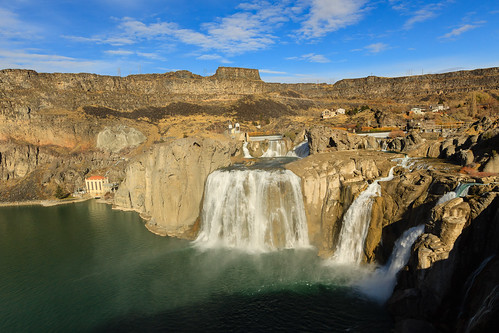
    We actually woke up fairly early on Monday, checking out of the hotel a little after 9:00 and grabbed breakfast at the nearby Shari’s. But, Twin Falls had something I wanted to see: the falls. Just north of town, the Snake River cuts a fairly deep slot canyon in the valley, and here, the river tubmles 212 feet down Shoshone Falls. So we drove out to the falls after breakfast and played around for a while, taking the dogs on a walk to one of the overlooks and just enjoying the warm air and sunshine. It was a beautiful sight, but by the time we actually hit the road, it was noon again.

    Shoshone Falls

    From Twin Falls, it’s about an hour to the Nevada Border where the small casino town of Jackpot lies. It’s about another hour to Wells, where we intersect I-80, but continue through. It’s about 2 more hours to the town of Ely, gateway to the Great Basin. But between Wells and Ely, there is virtually nothing. In fact, there was a sign just out of wells reading “Next Gas 126 Miles.” To add to the nothingness, the road is fairly straight, often continuing for 10 miles without requiring the use of the steering wheel. There is only one major intersection in this stretch, and there used to be a gas station there. Now it sits empty and the residents have an army of peacocks.

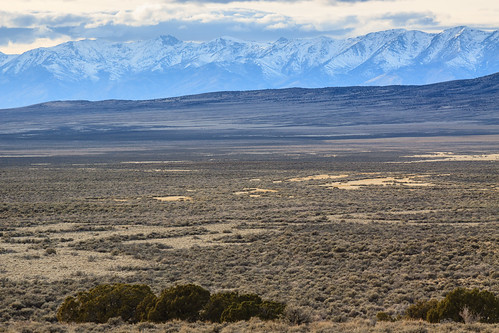
    As desolate as northern Nevada might be, it’s not all bad. The valleys are wide and flat, but flanked by some rather tall mountain ranges. It’s particularly nice to drive in November because the mountains are snow-capped, though had this been late Spring or early Fall, I would have been tempted to take a side road into the mountains and camp.

    Ruby Mountains

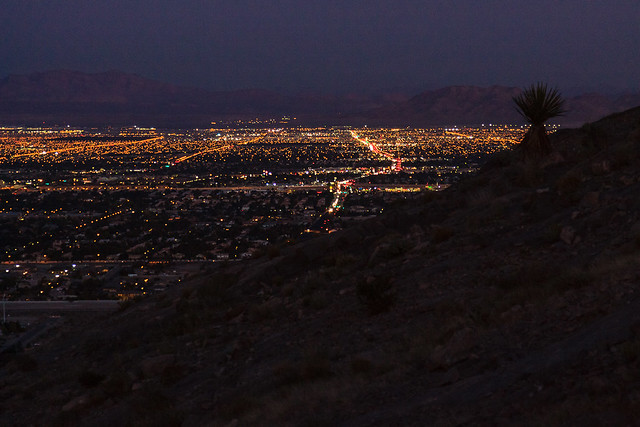
    By the time we made it to Ely, it was dark, which meant no more gawking at the awesome landscape. It also meant a 4-hour drive in the dark, which just made the time go by that much slower. Driving through Nevada just makes you aware of how lonely you can be. This landscape is dark at night. If you’ve never driven through these parts of the destert Southwest at night, you have no idea just how dark it is. This is one of the only places in the lower 48 states where the light pollution drops to almost zero. In that regard, Nevada is awesome. I just wish it had been a clear night. As we got closer and closer to the city, I began to notice a faint glow emanating from the southern mountains. It became apparant just how bright civilization can be as we approached our intersection with I-15. The truck stop in the middle of the desert put out more light than the entire town of Deary during a football game. Once on the interstate, we were about 15 miles out of town. As we crested over the final pass, the ocean of light revealed itself. Suddenly, you go from feeling completely alone to wondering if you were going to have any personal space in the valley. In any other metropolitan area, the transition from rural to urban is somewhat gradual. In Las Vegas, it’s as stark as transitioning from dry land to ocean.

    Urban Light

    Welcome to suburban sprawl in the southwest.

    Coming up…

    Part II: Visiting friends and playing in the desert.
    Part III: The drive up.