Spring Wildflowers and McCroskey State Park
When I started this blog, I never intended to make daily posts, but then, I thought that maybe I could come up with enough content to post more than once a month.
This month’s post is all about Spring wildflowers on the Palouse, because I’ve found some new ones and re-photographed some old favorites. To begin, I had realized that after three years of watching the Larkspur add a magnificent splash of purple to our yard, I had yet to put this plant in front of the camera. As common as it is, Larkspur might be one of my favorites simply because the deep hues are also extremely vibrant which makes this flower very noticeable even from a distance. So, let’s take a look at the larkspur:

Isn’t it wonderful? The purple creates such a nice contrast with the green grass, you can’t ignore it. And the best part of all this: it’s native. This isn’t some invasive exotic which usually colonizes disturbed areas such as yards. It actually grows wild here in the northwest. Larkspur is of the genus Delphinium. In case that name rings a bell, there is a cultivated Delphinium which really looks nothing like the D. nuttallianum pictured above. But then again, very few cultivated garden flowers resemble their wild cousins.
While I was photographing some of the larkspur, I happened upon four Camas plants, three of which are in bloom. During my first spring, I had been looking for Camas. After all, the Palouse prairie habitat closely resembles that of a Camas prairie. I first found Camas last year after hiking in the national forest. This year, the Camas seems to be everywhere. The four plants in my yard are a welcome find. I don’t know if I simply overlooked them in the past, or if this is the first time they have appeared on my little wildflower hill.
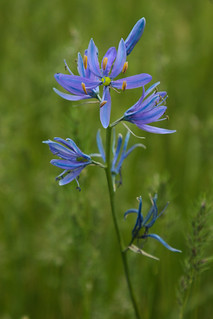 By the way, the Common Camas shown here is not the same as the toxic Death Camas. The bulbs of this plant are quite edible and have been collected as a food source by the native Americans and Lewis & Clark.
So far, this all seems great. I’ve finally photographed the Larkspur and discovered some Camas in the yard. You know what’s not so great? Trying to photograph these flowers. I’ve now been starting to walk for two weeks, but my leg is far from healed. I can bend my knee more than 90º, but still not all the way, and I surely can’t get into all of the positions I’d like to be in to photograph small flowers on the ground. It took some fancy maneuvering to get me on the ground only to find I was too close for my lens’s focusing abilities. I really do need a true macro lens for this work. I also can’t wait until I can properly kneel and roll around as needed for wildflower photography.
Ok, so that brings us to Sunday. I really wanted to go for a scenic drive with some geocaches to find along the way. Since it was already 2:00 before we were going to leave, I chose a route relatively close to home: Mary McCroskey State Park. This park is located just north of Potlatch in the mountains bordering the Palouse. The road through the park is named Skyline Drive. Like the more famous road of the same name, it’s a very scenic drive, but the similarities end there. This drive is unpaved and doesn’t contain pull-off overlooks. It’s not much different from a well-maintained Forest Service road. The route does wind its way through a mix of old-growth and logged habitats, and the abundance of wildflowers is nothing short of amazing.
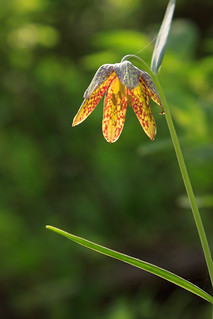
At this time, the Trillium were at the end of their flowering stage and the Calypso orchids were out in full bloom. On parts of the drive, the bluebells were withering away, but in other locations, they were as strong as ever. In the midst of admiring all of the color, Erin noticed something new: a lily of fairly dull coloration with brown splotches. This flower was so camouflaged that I couldn’t even find it when we first stopped to look at it. This is the Chocolate Lily (Fritillaria lanceolata), and for all of its “dullness” on the outside, this is really one beautiful flower on the inside. Once we found this flower, we saw it everywhere along the rest of the drive. In fact, it may be the dominant flower in bloom on this day.
Today was also Erin’s first sighting of Clematis in the wild. I had seen this flower before, but it was never in a pretty location to get a good picture of it. In fact, I thought the Clematis was a non-native, but I was wrong about that one. It’s just as native as the Larkspur.
As we made our way closer to the Palouse, the habitat and the floral communities changed. The cedar and spruce gave way to pines and the forest became more open and dry. The yellow flowers — Heart-leaved Arnica and Arrowleaf Balsamroot — became the dominant flowers. Shooting star became more common as well. The last surprise of the day was a Lupine in full bloom out in a clearing before we headed down the mountain to return home.
It was a great day to be out exploring and enjoying the landscape. It was a bit hazy to really enjoy the wide open views of the mountains and the Palouse, but there aren’t very many of those on this road anyway. The real gem is enjoying the flora and fauna of the forest. Later, when I can walk again, I’ll return and enjoy some of the many trails in the park and see what’s available away from the road. I’ll have to return anyway. I only logged two geocaches and there are more to be found.