Hiking Deary


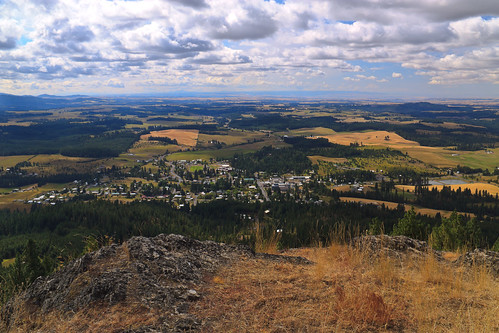
View from Potato Hill, originally uploaded by Matthew Singer.

I’ve now been in Idaho for almost three weeks and I’m starting to get settled into my new home. Later I will post about the property and the abundant wildlife that make our place so special.

But today, I write about a local hiking opportunity just over a mile down the road in the town of Deary. I have a theory that all cities and towns have an overlook, a spot from which you can stand and look down upon the population center. Sometimes these overlooks are only a few feet above the town itself. Sometimes they are man-made structures. But in mountainous and hilly regions, the overlook is most certainly a natural feature seen from the town itself. Of course there are many exceptions to this rule, but I find in most of the places I’ve been that the rule stands strong. In some cases, you can simply drive up to the overlook. In others, you can hike. And in rare circumstances, you have to bushwhack or even tresspass on private property to get there.

Deary is no exception to the rule. Just behind the town to the north stands a hill a thousand feet above with a break in the trees and some cliffs on the summit. When I first drove through Deary in February, I wondered if the land was public property and if there was a way to the top. I now revel in the fact that the answer to both questions is “yes.”

The trail up Potato Hill is designated a restricted use road available for all modes of transportation except automobile. So I was expecting to pass a few people on ATV’s or even horseback, but during my hike today, I passed only one person, and he was hiking with his dog just like I was.

It’s two miles and about 1200 vertical feet from the town center in Deary. About half way up, the road ends at a communication tower and the trail becomes, well, more trail-like. In fact, there was hardly any signs of recent ATV use, so I suppose most people hike to the summit if many people go up there at all. The trail winds through an mix of open forest and grassy meadow and has a great prospect for wildlife sightings. As you increase in elevation, the slope becomes steeper and the forest becomes denser, when suddenly the forest breaks altogether and a series of cliffs open up a view over the Palouse. The hike is pretty mellow until the last jaunt to the summit where the trail turns straight up and becomes populated with loose rock.

Nevertheless, the view from the summit is exquisite. The town of Deary, population 500-something, lies just below to the South. Beyond is the mix of forest and field of the eastern Palouse. To the West, you gaze upon Moscow Mountain and watch as the Palouse suddenly ends with a series of canyons off in the distance. Below, but out of sight, is the Clearwater River and the city of Lewiston. To the east, mountains rise and get bigger with each layer.

This is a short hike, easily achieved in less than half a day, but nice to have so close to home. And yes, there are bigger mountains with taller views, those will be explored in due time. But this looks to be my go-to hike when I’m too busy to go farther afield.
Similar Posts

  • |

    Old Rag

    Spring!, originally uploaded by Matthew Singer. In April, I briefly lost my camera due to a bent pin in the card slot. I sent it to Canon for repair and got the camera back in a week’s time. Unfortunately, during that time, I had scheduled a hike up Old Rag with Jon, my supervisor at the time. So, after a trip to Fed Ex, I stopped at the camera store and bought a couple rolls of film. I’ve finally had the chance to get the old scanner out of the box and get this set of slides scanned and uploaded….

  • |

    Evo-WIBO and the Olympic Peninsula

    I’m two weeks on this post, but forgive me because the last two weeks of the semester have been insane. The bi-annual northwest evolution conference, Evo-WIBO, occurred the last weekend of April. If you don’t remember, I attended the last meeting two years ago and presented a talk on the results of our selection experiment. This year, I presented a poster (my first) on the use of function-value trait analysis to analyze video tracking data. In short, we can use functions to describe behaviors over time and use more details in the data than if we were to simply distill…

  • | |

    Exploring

    The past week, my parents were in town visiting and we spent the week exploring and showing them our favorite places in the area. We’d usually leave fairly early in the morning and get back kinda late, always exhausted. As a result, I haven’t been able to post some detailed updates on the awesome places that we’ve been. I’ll try to summarize the week here. Saturday, July 23: Picked my parents up from the Lewiston airport. Turns out, there was some kind of airplane festival going on so we decided to have a look. There were planes out on the…

  • Freezeout

    The heatwave has hit the northwest. Today’s temperatures on the Palouse rose into the high 90’s, and tomorrow it may break 100. I wanted to hike so I can get in shape for backpacking next month, so I thought I’d take the dogs up to Freezeout Saddle and hike to Grandmother Mountain. But when I got up there, it was also hot and somewhat muggy, so we didn’t make it very far. I brought the camera, but got no pictures on this trip. The summer wildflowers are starting to bloom: beargrass was in its early stages, and the lupine had…

  • Wallowas Weekend 2015

    After a long summer with not much exploring, the pace has changed and I’ve had a fairly busy two weeks. The series begins with the return of the Annual Wallowas Weekend. In the six Septembers that I have lived here, I’ve led a backpacking trip to the Eagle Cap Wilderness four of those years, with this year being the fourth. Each time I bring someone new, and each time we explore new trails. This is the first year that we didn’t spend a night at Mirror Lake and the first year that Tyler didn’t join us. Instead, Wesley returns for…

  • East Peak

    There are many peaks in the Wallowas that top 9000 feet, so East Peak might go unnoticed if it weren’t so easily accessible. It turns out that I’m not the only one who thought to use the Wallowa Lake Tramway to cover the first 3700 feet of elevation, reducing the climb to the peak to 1300 feet. This hike is featured in the book, and while I was’t expecting a crowd, we did pass three other hikers along the way, two of which are local to the area and hike to the peak regularly. The Wallowa Lake Tramway brings you…