Upper Basin Trail


View Upper Basin Trail in a larger map

The Upper Basin Trail is a 5 mile loop in the upper basin of Elk Creek just north of Elk River The trail is near the giant western red cedar, thought to be the largest tree in the U.S. east of the Sierra-Cascade crest. The loop is also near the Morris Cedar Grove, another grove of large old-growth red cedar. unfortunately, the road to the Morris Grove was closed and blocked off on Saturday.

If you’re looking for a difficult challenge, the Upper Basin loop is not for you. The trail was built as an interpretative trail with markers along the way. The markers are just numbers and likely correspond to a brochure to carry with you, but there were no brochures to be found at the parking area. The trail itself is quite easy. The total elevation gain is about 400 feet and much of the trail runs along an old railroad grade which is flat and soft.
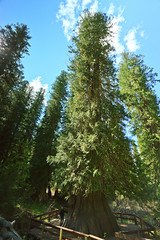
Giant Western Red Cedar
The Giant Red Cedar
The trail is scenic, but don’t come looking for grand vistas or picturesque stream scenes. Instead, it winds through some of the typical ecosystems in the area: logged forest (regrowth), marshes, meadows, and some more mature forest. I suspect that hiking this trail early in the morning would provide plenty of wildlife sightings. I passed numerous evidence of moose and elk and a few scat piles that may belong to wolf. This is definitely a trail that the whole family could enjoy and it seems to receive little use compared to the Elk River Falls and the Giant Tree, so it’s also a good way to escape the crowds. To get to the trailhead, travel to the town of Elk River, Idaho (Rt. 8 East from Moscow), turn left onto N. Front Street and stay straight on this road. It will eventually turn into a gravel road. At the fork, take the right Fork onto Forest Service Road 382 toward Upper Basin. In about 8 miles, turn Left onto a short spur that leads to the trailhead and parking area.
GPS coordinates: N46 53.075, W116 09.674
Clearwater National Forest trail #747

About 2 miles beyond is the giant Western Red Cedar. This tree is thought to be the largest tree east of the Cascades and Sierras. It measures 18 feet in diameter at breast height and measures 177 feet tall. It is estimated to be about 3000 years old. This short walk through an old-growth cedar grove is short and mostly handicap accessible, though not 100%. There is also a bathroom at the parking area. If you’re in the area, a trip to the tree is worth the visit.

Similar Posts

  • |

    A walk in the snow

    Well, now that Winter has finally arrived, we thought it might be fun to tromp through the snow and get some exercise. I dusted off the snowshoes (literally) and we set off for a little hike out of our back yard. As we began our trek, I noticed an awesome mist hovering over the snow, and since we hadn’t left the yard yet, we turned back to get my camera. We were walking in snow that had not been disturbed, so it was quite soft and difficult, even with snowshoes. In fact, in the hour that we were out, we…

  • Attempting to Snowshoe

    This past weekend, we had a nice day on my day off for once. So I took advantage of the sunshine and warm weather to get out and hike. Or so I thought. I’ve been waiting to take my snowshoes out for a real winter trek, and the timing has been bad. I set my sights on the Gold Center trail, which leaves at the base of the mountains behind Clarkia and climbs its way up to the ridge just below Grandmother Mountain. I’ve always wanted to hike this trail, and winter seems like the best time to do this…

  • Eagle Cap Wilderness, Labor Day Weekend

    A year ago this weekend, I set foot in Oregon for the first time and explored one of its most beautiful and least advertised mountain ranges. Last year, we only got a preview of the Eagle Cap Wilderness in the Wallowa Mountains, only able to stay one night. So this year, I arranged the backpacking trip for Labor Day Weekend, which let us spend 3 nights in the wild and explore more of the area. I rarely return to the same place for a second trip as there is so much around to explore, but then, there is the trade-off….

  • Elk Butte

    Ever since I first visited Elk River during my interview trip in February 2010, I had a desire to get to the top of Elk Butte. After all, who could resist a lookout tower boasting 3000 foot views? The only problem was finding a suitable way to get up there. While the maps show a road to the summit, descriptions also warn that the summit is not accessible by car. Most people reach the summit by four-wheelers in the summer and snowmobiles in the winter. I had read that it was a 7-mile one-way trip, which ruled out a day…

  • East Peak

    There are many peaks in the Wallowas that top 9000 feet, so East Peak might go unnoticed if it weren’t so easily accessible. It turns out that I’m not the only one who thought to use the Wallowa Lake Tramway to cover the first 3700 feet of elevation, reducing the climb to the peak to 1300 feet. This hike is featured in the book, and while I was’t expecting a crowd, we did pass three other hikers along the way, two of which are local to the area and hike to the peak regularly. The Wallowa Lake Tramway brings you…

  • Oregon

    Sunrise, originally uploaded by Matthew Singer. I made my very first appearance in the state of Oregon over the weekend. I’m impressed and hooked. Oregon is a very pretty state, and I didn’t even get to see very much of it. My Oregon experience took me to a little known section in the northeastern corner, the Eagle Cap Wilderness Area in the Wallowa Mountains. I went with two other grad students in the department for an overnight trip to Mirror Lake in the heart of the wilderness area. We left Friday night just as the sun was setting and drove…