My Research: What I have been up to
Last week, the fruits of my last three year’s work has finally come to fruition in the journal PLoS One. The premise is that the personality behavior we call boldness, or the bold-shy continuum, is not only heritable, but a genetically correlated multivariate trait. The research is essentially a continuation of a project Mary Oswald completed for her dissertation, however upon first submission, reviewers criticized the study for its lack of replication. So, in the Summer of 2010, she set up a second selection experiment which I took over and have been maintaining since.
Boldness is an interesting behavior to study in animals. As a personality behavior, individuals with a particular boldness score relative to the population tend to remain that way for the long-term, and while there is some plasticity between contexts, individuals that are bold tend to remain bold, and individuals that remain shy tend to remain shy, and populations can evolve toward one end or the other based on selection pressures. Of course, the best way to really get this point across is to see some videos exhibiting just what boldness and shyness represent.
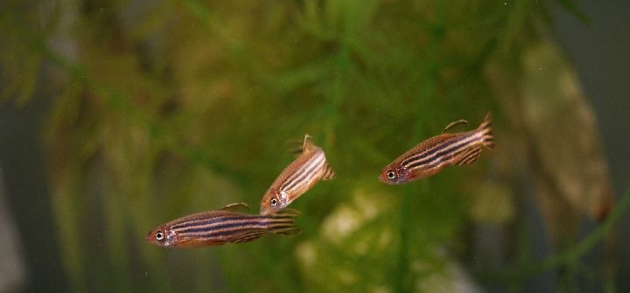
These are Zebrafish, Danio rerio. The top tank, labelled “Nadia,” contain a wild strain, but these fish aren’t taken directly from the wild. Instead, these are the 4th generation from wild fish to be raised in captivity right here at the University of Idaho. Notice how they prefer to swim at the bottom of the water column and shy away from a human presence. Now contrast that with the bottom tank containing fish from the Scientific Hatcheries (SH) strain, which are more than 30 generations removed from captivity. They not only spend more of their time near the top of the water column, but are also un-phased by a human presence. In fact, if they do react, it’s to come closer to a human observer rather than to shy away. This observation in contrasting behavior between wild and domestic populations has been repeatedly observed in a number of different species including trout, salmon, birds, mice, rats, dogs, and foxes. The question is: why?
Now, your first thought is that this might be a result of rearing environment. Domesticated animals grow up around people and are therefore not afraid of them. But, remember that both of these populations were reared in the same environment. The “wild” fish have never seen their native habitat and were raised with the same human contact as the domesticated fish. When the environments are equalized, differences must be due to genetic differences.
One way to test this hypothesis is to select upon these behaviors. Simply put, selection doesn’t act on a trait if there is no genetic variation controlling variation in that trait. We took a random sample of 80 SH individuals and behavior-typed them by taking 24 point observations over the course of a week scoring whether they were within one body length of the front of the tank near the observer, or not. The observations are averaged to create a “boldness” score. The five highest scoring males and females were mated to create a “bold” line, and the five lowest scoring males and females were mated to create a “shy” line. For each of these observations, we also recorded the location in six vertical depth zones to come up with a depth preference measure. Once each day, we measured feeding latency, the time it takes for an individual to feed from the surface of the water.
After two generations of selection, we were able to estimate the heritability, that is, the proportion of behavioral variation that is attributed to genetic variation, and the genetic correlations using a REML analysis. The gist is that these three behaviors have a significant, but moderately low heritability (between .25 and .3) and fairly strong genetic correlations (between .6 and .8). What this means is that selection can, in fact, act on these behaviors, and that selecting on a single behavior will also induce a response in the other two. As I stated earlier, these results have finally been published in PLoS One, and because it is an open access journal, you can actually read the paper free of charge.
One of the implications here is that the behavioral differences between captive and wild populations of the same species are due to an evolutionary response to the captive environment. Of course, it could be that in captivity, humans will artificially select for bolder behaviors either intentionally, in the case of the pet industry, or unintentionally, either by selecting on traits that are correlated with boldness, or because bold individuals are simply easier to catch for the mating process. However, there is a hypothesis that shyness is selected for in the wild by predators (we assume that a human observer represents a potential predator), and that in the absence of predators, boldness might be the more fit phenotype. Bold individuals are risk-takers. They’re more likely to be seen in the open foraging for food where they are in risk of getting picked off by a predator. Shy individuals are more likely to hide and wait until it is safe to eat. The trade-off is that while bold individuals risk their lives, they consume more resources which they can invest in growth and reproduction. On the other hand, shy individuals live longer, and might produce more offspring over their lifetime. In the absence of predation, bold individuals will still frequent the open habitat and feed sooner than the shy individuals, but they won’t be picked off. Thus, there is the potential that they can produce a higher quantity and quality of offspring than shy individuals in captivity. This is also confounded by the observation that shyness is correlated with anxiety and stress. Highly stressed individuals are unable to allocate as much energy toward reproduction compared with unstressed individuals. Anxious animals in captivity don’t breed as well, and we’ve noticed this trend while trying to breed our wild lines of zebrafish in the laboratory. I hope to test this hypothesis in the near future by bringing in some new populations of zebrafish from the wild and measuring fecundity and behavior.
In addition to linking boldness with fitness, I’m also interested in the nature of the genetic correlations among our three boldness components. Heritabilities and genetic correlations are population specific. Just because we’ve estimated these numbers in one population does not mean they hold true in another population. That is because heritability is linked to allele frequencies, and those are going to change from population to population. In fact, they’re going to change within a single population over time, especially if selection is acting upon the traits. Genetic correlations, on the other hand, can be somewhat stable depending on their origin.
There are two ways to generate a genetic correlation. One is to create linkage disequilibrium (association of alleles at one gene with alleles at another) by selecting on two or more traits simultaneously. For example, if blonde hair and blue eyes were preferred traits in a population of humans, the genes for each trait would fall into linkage disequilibrium. Normally, recombination would disassociate the two traits from one another, but with preference for both, blue eyes and blonde hair would both rise in frequency in the population in such a way that if you sample an individual at random, he’d likely have both blonde hair and blue eyes. Since the traits are now correlated, selecting on only blonde hair will still select for blue eyes because the occurrence of blonde hair and brown eyes is relatively low.
The other way to generate a genetic correlation is if two traits share the same genes, also called pleiotropy. Suppose eye color and hair color are controlled by the same gene. In this case, the allele for blue eyes (lack of pigment) also produces blonde hair (lack of pigment). If these traits were controlled by a single gene, it would be impossible to disentangle hair color from eye color. However, quantitative traits such as these are much more complex. There are many genes that control your hair color, and many that control your eye color, and it’s likely that some of them are shared through pleiotropy, but many of them are not.
In this respect, I am interested in understanding the genetic architecture of boldness. How many genes likely control each behavior and are they linked through pleiotropy? How similar are the correlations in other populations? There are a number of ways to get at these questions. One is to perform a QTL which involves looking at variation across the genome for areas in which genetic variation correlates with behavioral variation. In doing this, we can begin to understand how the genome can influence behavioral traits. The other is to measure heritability and genetic correlations in other populations. The resulting G matrixes can be compared, mostly looking for rotation. If the matrixes align, then correlation structure is conserved. That isn’t conclusive proof that each behavior is linked by pleiotropy, but it might explain why the same sorts of behaviors vary in the same direction between wild and domestic populations.
In other words, behaviors associated with the bold-shy continuum may be constrained to always evolve together during domestication events. That is the overall hypothesis and theme of my doctoral dissertation.