Shoot for the Stars

Stargazing I
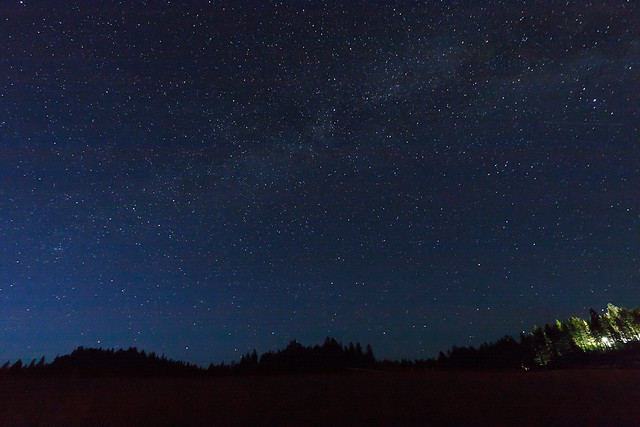
The night sky from my yard.

Last night, I had some folks over from the photo club for a little get together and fun. We grilled burgers, sat around the fire, and played with our cameras. We were mostly interested in shooting the night sky. I’ve shot the stars before, but last night might be my most successful attempt yet.
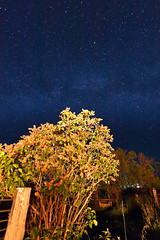
Stargazing IIShooting the night sky is rather difficult, but it can be quite rewarding. One can end up with an image with more stars in it than the eye can see. The problem is that stars are not very bright, so to capture enough light, you have to use a long shutter speed. Therein lies another problem: stars move in the sky. One solution is to expose for a very long time and capture the star trails. With digital photography, this is a somewhat difficult approach. For one, the sensor is using battery power to capture the image. So the longer the exposure, the more battery gets used. An all-night exposure is nearly impossible. Using film, you can open the shutter forever and not draw any power.

The other option is the “short” exposure, and by short, I mean keeping it to 30 seconds or less. Even at 30 seconds, we begin to notice movement in the stars, but it may not be so much to detract from the image. The images on this post were taken at 30 seconds, but you only see star movement if we blow the image up pretty big. There one last trade-off to consider. Do you want a night sky with lots of stars and milky way detail, or do you want your image to be crisp and sharp all around? To get lots of light, you need a large aperture, f/2.8 or larger. But while large apertures let in lots of light, they’re also difficult to focus and lenses aren’t usually their sharpest at their widest aperture. Stopping down can get you a crisper image, but you’ll only pick up the brightest stars. But with practice and lots of patience, you can have your cake and eat it too.

Similar Posts

  • |

    Daffodils in the Snow

    Daffodils in the Snow, originally uploaded by Matthew Singer. I’ve heard of April showers bringing May flowers, but what do April snows bring? On Friday, I awoke to a white world with about an inch of snow covering everything. It was kind of a shock considering only a week before, there were promising signs of Spring. Of course, after the snow, the temperatures are back up and the weekend’s forecast is quite pleasant.

  • |

    The Birds at our Feeder

    We get lots of birds in our trees in the front yard. This could be contributed to the source of food we are supplying to them. The list of winter birds is less than the summer residents. For example, I haven’t seen a bluebird in months, and most of the woodpeckers have left the yard too. And of course, the hummingbirds have gone since they don’t have the proper gear to tolerate the cold. But even with the few remaining species, watching the feeders has been a delight. In Idaho, we have the possibility to see four different kinds of…

  • |

    Kamiak Butte

    The Palouse, originally uploaded by Matthew Singer. The Palouse is made up of rolling hills covered in wheat and barley fields. This area was historically a prairie, so there were few trees to begin with. A few of these hills rise up well above the rest, remnants of a time when the region was more active volcanically. Kamiak Butte is one such high point, located less than 10 miles north of Pullman. The north slope is covered by a lush and beautiful forest, protected as a county park for all to enjoy. The park offers a picnic area, a campground,…

  • |

    Aurora

    We got alerts that a solar flare could cause an aurora that would be visible into the middle states. So, last night, I checked the sky and luckily it was clear to the north. I saw a faint glow on the horizon and set up the camera. Sure enough, there was an aurora. The excitement didn’t last too long. I wanted to view this one from Steptoe Butte, one of the best places around for viewing auroral activity. So, we got in the car and started driving west. Unfortunately, the sky was overcast over much of the Palouse, and by…

  • Fall Foliage

    Foliage, originally uploaded by Matthew Singer. With the sudden drop in temperatures, Fall has officially begun in the northwest. This is the first time I’ve spent fall in a predominantly evergreen forest. While there is color to be found in the west, I suspect that the immediate area won’t be the place to find it. But, as fall rolls in, I provide a tribute to the spectacular display before the forest retires for winter.

  • |

    Aurora

      This story begins Friday night when I learned that a large coronal mass ejection (CME) sent a burst of solar radiation from the sun headed toward Earth. It was predicted to intercept our atmosphere on the evening of the 8th, producing auroral activity in the high latitudes. Given the size of this solar storm, as described by spaceweather.com, I was a bit suspicious that the auroras migh be big enough to see all the way down here in northern Idaho. So, I kept a watch looking for evidence of such activity. On the evening of the 8th, I checked…