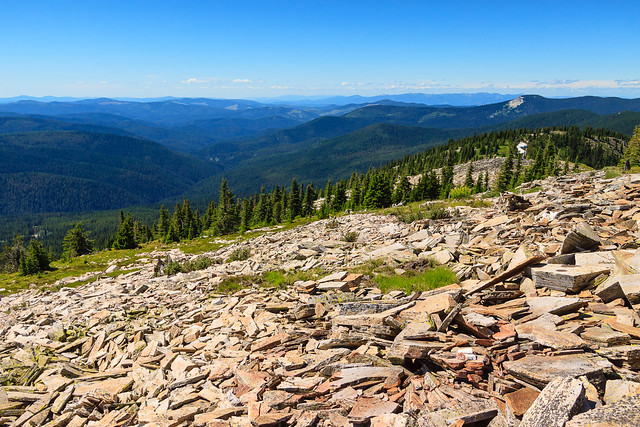
Lookout Mountain

View North

Everytime I’m up on Grandmother Mountain, I look to the east and see the bald dome of Lookout Mountain rising over the Marble Creek drainage and I long to stand on top and look down from the other side. Finally, with my parents and sister visiting, I decided this would be the perfect opportunity to try out this trail.

There are several mountains in northern Idaho named Lookout. This is not the ski area on the Idaho-Montana border off of I-90. This is not the peak in the Selkirks north of Sandpoint of the same name. This is in the St. Joe National Forest, accessed from FS-301, the same road that leads to Freezeout Saddle and the Grandmother Mountain trail outside of Clarkia.

Lookout Mountain is unique for this area because its summit is completely bald, offering spectacular views in 360 degrees. The summit stands at 6789 feet above sea level and overlooks Lost Lake, the nearest glacial tarn of considerable size to the Moscow Area. This trail is absolutely beautiful and probably seldom used compared to the neighboring Grandmother Mountain trail. The trailhead is only 7 miles farther down the road, but due to the rough road conditions, it took an extra hour of driving to get there. Despite its apparent remoteness, the trail and trailhead are in great condition. The trailhead features several developed campsites with picnic tables and fire rings along with a well-maintained privy. There are also two other small campgrounds nearby. Next time I hike this trail, I may have to spend the night.

From the trailhead at Orphan Saddle, it’s a 4-mile walk to the summit of Lookout Mountain. The trip isn’t very difficult, though you’ll begin your journey with a 600 foot ascent in just under a mile. By the time you start getting tired, you reach the ridge at 6500 feet and the journey becomes a relaxing meander through a mixture of hemlock forest and grassy field. The next two miles are gentle, holding elevation until the Widow Peak trial splits off, and then gently descending into the saddle above Lost Lake. The last mile is a 700 foot ascent to the summit, and though it may seem steep, you’re on the spine of the ridge with views that get better with every step you take. Take as much time as you need and eventually, you’ll find you can’t go any higher.

The return journey isn’t too bad. The descent on the way out was gradual and not very noticeable, but you may notice the uphill on the return. However, it’s still gentle compared to the two ascents (now descents) on the way out. In short, this may have become my new favorite local hike. Unfortunately, it is such a pain in the butt to get to that I’ll probably still stick to Grandmother Mountain as my go-to escape to higher elevations.
Map and elevation statistics

More Photos

Similar Posts

  • Elk Butte

    Ever since I first visited Elk River during my interview trip in February 2010, I had a desire to get to the top of Elk Butte. After all, who could resist a lookout tower boasting 3000 foot views? The only problem was finding a suitable way to get up there. While the maps show a road to the summit, descriptions also warn that the summit is not accessible by car. Most people reach the summit by four-wheelers in the summer and snowmobiles in the winter. I had read that it was a 7-mile one-way trip, which ruled out a day…

  • Freezeout

    The heatwave has hit the northwest. Today’s temperatures on the Palouse rose into the high 90’s, and tomorrow it may break 100. I wanted to hike so I can get in shape for backpacking next month, so I thought I’d take the dogs up to Freezeout Saddle and hike to Grandmother Mountain. But when I got up there, it was also hot and somewhat muggy, so we didn’t make it very far. I brought the camera, but got no pictures on this trip. The summer wildflowers are starting to bloom: beargrass was in its early stages, and the lupine had…

  • Snowshoeing: Spud Hill

    This snowshoeing thing is taking off, and if I keep this up, I’ll be in shape enough to not suck at hiking at the beginning of the hiking season. This week’s adventure brings us up Spud Hill, also known by some as Mount Deary. Spud Hill was my first Idaho summit, and it’s a great little local hike that I often overlook. But I’ve always wanted to hike it in the winter, and today, Spud Hill became my first winter Idaho summit. The one difference between snowshoeing and hiking, aside from the snow on the ground, is that distances seem…

  • Asotin Creek… sort of.

    The photo above was taken in February of 2010, my first visit to Asotin Creek. I’ve been back a couple of times as it is usually a reliable winter hike that is free of snow. I had never gone down in the spring when everything is green, and certainly not in the summer when temperatures can reach the 100 degree mark. So it was that Erin and I decided to spend a day down at Asotin Creek. The local wildflowers should be in bloom, and the hills might show hints of colors other than the drab brown of dried grass….

  • Snowshoeing Moose Creek

    Last week, winter returned to the Palouse. We got about six inches of snow in Deary, most of which was still around over the weekend. On Sunday, I joined a group of students and post-docs for a snowshoeing trip to Moose Creek. Although it was a foggy and overcast day, we had a great time. I’m always amazed at how much more snow Moose Creek gets, despite its close proximity to home. I estimate the snow was about a foot deep, which is plenty for snowshoeing. We ended up hiking just under 2 miles in before turning around and heading…

  • |

    Evo-WIBO and the Olympic Peninsula

    I’m two weeks on this post, but forgive me because the last two weeks of the semester have been insane. The bi-annual northwest evolution conference, Evo-WIBO, occurred the last weekend of April. If you don’t remember, I attended the last meeting two years ago and presented a talk on the results of our selection experiment. This year, I presented a poster (my first) on the use of function-value trait analysis to analyze video tracking data. In short, we can use functions to describe behaviors over time and use more details in the data than if we were to simply distill…