Month: April 2012

  • Evo-WIBO weekend recap

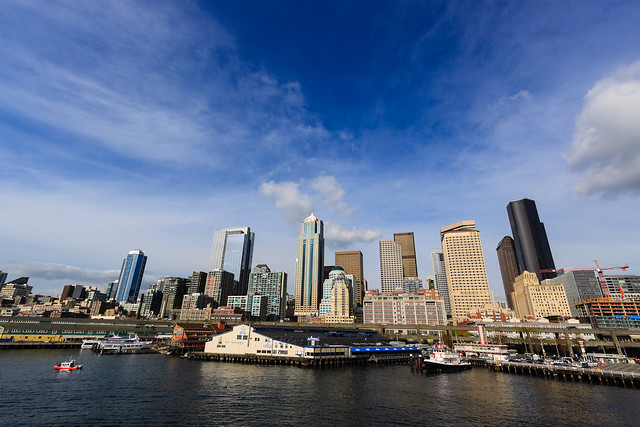
    Seattle Skyline

    This past weekend, I was in Port Townsend, WA for the bi-annual Evo-WIBO meeting. Evo-WIBO is a small, regional gathering of someo of the biggest names in evolutionary biology in the Pacific northwest. Its only a day and a half long and very informal. Yet, because of its size and intimacy, I got more out of this meeting than I did when I presented at the much larger SICB meeting in January. I met and hung out with more people than I would have, which made it a lot of fun. The only downside is that it was so nice out that I felt bad spending the day inside instead of being out exploring a new place.

    My talk went well. I presented the results from our selection experiments, but dropped the open field data due to time constraints. Instead, I added the little bit about the dimensionality of the G-matrix that we estimated. My talk was near the end of the day, and I was the first person to mention the G-matrix all day, which I heard got a nod from Steve Arnold.

    Fort Worden is a decomissioned WWII fort on the corner of the Olympic Peninsula. There are gun batteries positioned throughout the grounds, but much of the land is forest or beach. The barracks have been converted into a convention center, which is how we got to have our conference at the park. This is great birding habitat, and wouldn’t you know it? I left my binoculars at home. On a clear day, there are spectacular views of the Mt. Baker and the northern Cascades across the water, and from the right vantage point, you can even see Mt. Rainier to the south.

    Port Townsend is a nice little town. It’s definitely built for the summer tourist season, but it seems like a place worth coming back to explore. The little downtown area is packed with shops and restaurants. I figured that since I was on the coast, I’d get seafood for dinner, and I had the best crab riggatoni ever. Unfortunately, I didn’t get to spend much time in town beyond dinner, so perhaps I’ll return when I get a chance to explore the Olympic Peninsula. The next meeting will be in two years, so I’m hoping I’ll be in a position to take some time off while I’m out there. It’s such a long trip for only a day and a half. From Moscow, the trip can be made in 6.5 hours, but it generally takes longer with meal and bathroom breaks. The bulk of the drive isn’t very scenic either. There’s a good two-hour stretch on open, flat land through central Washington that just seems to go on forever. It’s apparently faster to drive down to Tacoma and around the Puget Sound, but the ferry ride from Seattle to Bainbridge Island gives a much needed break from driving and a chance to enjoy the Seattle skyline and the mountains. Despite the clear blue skies, it was too cloudy to see the mountains on the way out, but on the way back, Mt. Rainier stood majestically above the landscape. It was an awesome sight.

    So to recap, Evo-WIBO is awesome, fun, and a great place to network and meet other people nearby in evolutionary biology.


  • Another conference, how about that?

    Somehow, I managed to go to two conferences in one semester. Tomorrow, I’ll be heading to Port Townsend, WA along with several other members of the department for the bi-annual Evo-WIBO conference. This is a small, regional conference for evolutionary biologists in the Pacific Northwest. There are only going to be around 200 or so people attending (compared to the 2-3000 at SICB), and there is only one talk session at a time. So lucky me, I got chosen to give an oral presentation.

    Did I mention it’s a small conference? It begins Saturday morning and ends Sunday at noon. All that for a 7-8 hour one-way drive. It’s too bad that I have to be back in Moscow on Monday because I’d love to stick around and explore the Olympic Penninsula a bit.

    Such is life, I guess.

  • Puppies for Sale

    Puppies at 8 weeks

    The puppies are now over 8 weeks old and oh so cute. As you can imagine, seven growing pups indoors can create quite a mess that is hard to keep on top of. On top of that, any time you step into their room, they all mob you for attention. So, as spring weather has descended upon the Palouse, we found scrap lumber and fencing and built an outdoor playpen for the dogs. So far it is doing the job. It’s also giving the pups some much needed fresh air and sunshine, which in turn tires them out so all they want to do is sleep when they come in at night.

    The dogs have quite a range of personalities. Some of them are going to be very active, great for life on a farm or as an outdoor companion. Two of them are quite mellow and would rather cuddle up with you. They’re all very friendly and very loving.

    So, the puppies are now ready for their own families. Did I mention that they are pure-bred German shepherds? If you’re in the Northwest area and would like a dog, or know someone who would like a dog, please contact me. I’d like to find them homes sooner than later.

  • LaTeX


    p' = \frac{w_{AA}p^2 + w_{Aa}pq}{w_{AA}p^2 + w_{Aa}pq + w_{aa}q^2}
     

    This semester, one of my classes has required me to turn in all of my assignments in LaTeX. LaTeX (la-tek) is built on TeX, a typesetting language meant to produce beautiful documents reminiscent of the days when papers were printed from engraved plates. Typesetting was an art that got lost in the digital age.

    When I first got the news that assignments were to be handed in using LaTeX, I admit I was a bit worried. The assignments were already going to be difficult enough since it is a bioinformatics class working with data types I have not been used to dealing with. On top of that, I’d have to learn a new system for typing up my homework. It has been a pain in the butt, but it has also been fun and pretty useful. One of the big advantages of LaTeX is its typesetting of mathematical formulas. It is easy and elegant, once you get used to the syntax. Anyone who has used the Microsoft equation editor that comes with Office knows it is a pain to work with. The point and click interface is slow and clumbsy. The LaTex looks ugly, but it also makes sense. The formula above reads as follows in LaTex:

    p’ = \frac{w_{AA}p^2 + w_{Aa}pq}{w_{AA}p^2 + w_{Aa}pq + w_{aa}q^2}

    The second advantage of LaTeX is that it can be completely integrated with R, the programming language that I use to analyze data. Natively, R outputs to plain text. But LaTeX integration with Sweave lets me run R code along with the TeX document and output data tables and graphics in a printable format, integrated with text. Plus, if I need to alter the R code, I can do so right in the Sweave document.

    Lately, I discovered a LaTeX plugin for wordpress that allows me to make mathematical formulas in LaTeX’s math mode. There’s currently no math typesetting for html, yet the internet is a great resource for learning about math topics. Unfortunately, the LaTex doesn’t integrate as selectable text, but instead is output as an image, but it’s a good start for now. Perhaps I can make some future posts that involve some mathematical modeling of biological topics.

    Since I have been using LaTeX for bioinformatics class, I have been using it to turn in assignments for other classes. It has been a useful medium for typing up Quantitative Genetics problem sets, and the presentation that I’ll be giving at Evo-Wibo in two weeks will be made using LaTeX. At some point, I’ll have to install Lilypond, a typesetting language for producing music notation.

    I’m a nerd, and proud of it.

    By the way, extra props if you understand the equation at the top of the page.