Hells Canyon
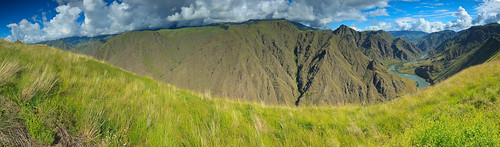
Panoramic View from our vantage point, originally uploaded by Matthew Singer.
This story begins with Luke and I itching to get out into the backcountry. Although it’s the middle of June, the combination of an unusually cold and wet Spring with the very productive winter has left many of the high country destinations (above 5000 ft.) still buried under 100+ inches of snow in places. And even some of the lower areas are still blocked with impassible snow drifts on the road. This makes our options quite limited.
The one place we’re sure to have access is Hells Canyon. With the river averaging 1200 ft. in between slopes that exceed 7000 feet, Hells Canyon is the deepest canyon in the United States. The Snake River cut a 200-mile ravine through a basalt plateau forming the western border of Idaho with Oregon. At under 1500 feet in elevation, the Snake River itself rarely sees snow and is warm enough for backpacking as early as March and as late as November. However, to get into the canyon, one must either float in from the town of Oxbow, OR or drive along windy roads over the 4500 ft. Pittsburg Saddle and down to Pittsburg Landing. While the road is plowed in the winter, the journey may still be treacherous to the casual traveler.
It is from Pittsburg Landing that we begin our hike. Our original plan had us hiking 31 miles in 3 days, ascending over 4000 feet out of the canyon from Kirkwood Ranch to Sawpit Saddle, and then returning to the Snake River via Sheep Creek on a trail that hasn’t been maintained in decades. It would have been an ambitious start to the hiking season. But we were unable to take 3 days for this, so we decided to tone it down and just stick to the Idaho Snake River Trail for about 10 miles or so, and hike back out the next day.
We began our hike huffing and puffing in the heat of mid-day. For a river trail, the Snake River Trail sure covers a lot of elevation gain. At our highest, I think we were 300 feet above the river.
Kirkwood Ranch is 5.5 miles south from the trail head. It was a working sheep farm back in the day, though as isolated as it is, it must have been tough living. Today, the ranch is a museum and ranger station. There’s also a backcountry campground on the old hayfield, though it offers such cushy amenities as flush toilets. We had planned to stop at Kirkwood for a late lunch break and then keep going, but we found out that the trail had been washed out less than a mile beyond and was rendered impassible. In fact, the “crowd” set up at the campground was mostly a trial crew in for a few weeks to repair the trail.
We had two options: We could take a detour, which entailed bushwhacking up and over a 2000-foot ridge to get back to the trail and keep going, or camp at Kirkwood and explore the area without packs. As we were already exhausted, the thought of climbing a steep incline with no trail and heavy packs only to be repeated the next day was not appealing. We found a spot, made camp, and went exploring.
Our destination Saturday evening was up the Kirkwood Trail, an ATV road that eventually led out of the canyon. We weren’t going that far, we headed up about a mile to Carter Mansion, and then up the hill looking for a vantage point. We were told that the views at the top of the ridge were first-rate, but the ascent would take about 3 hours. Tired and exhausted, we opted for a lower goal, a tree atop one of the landings on the way up. We made it within 200 vertical feet of the tree when Matt and I gave up and rested on a rock while Luke made way for the summit. When he returned, Matt decided to make a go for it. And when he returned, I felt as though I had to make my push for the top. So we all individually made it to our goal and then made our way back to camp for dinner.
I slept better than I had in a long while. I think we all did. We awoke refreshed and energetic with our eyes set on another high point just across the field from camp. It was a longer, and steeper climb, but we were rested and ready to go. We made it to the top, what was our top. The ridge kept going up. But from our “summit,” 1300 feet above camp, we had a glorious view over the Snake River. When we woke up and started, the skies were grey and overcast. It had actually rained during the night. But as we climbed that last push for the summit, the clouds broke and the sun came out.
Bushwhacking up a steep slope is actually the easy part. Coming back down is when there are more chances for injury. We took it slow and careful and eventually made it down to camp in one piece, though we were hurting. We rested, made lunch, refilled water, soaked our feet in the cold stream and packed up camp. Because we had made that climb, we set ourselves up to hike out in the heat of the afternoon, and there was no shortage of heat. The car read 83 degrees when we finally arrived back at the trailhead. The hike back wasn’t nearly as bad as the hike in, but we were still tired from the morning’s climb and it felt good to be back at the car.
The events that cut our trip short ended up making this a great first trip for the season. The summer temperatures in the canyon will make hiking along the river unbearable for the rest of the season, but we’ll have some chances to explore the high country as the snow melts and roads become accessible. Hells Canyon is a marvel of nature and worth a visit. The scenery is big and awe inspiring, and certainly humbling.
View Hells Canyon Hike in a larger map