Shoot for the Stars

Stargazing I
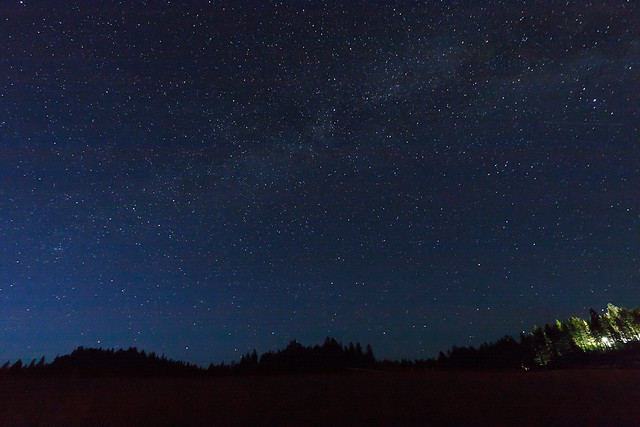
The night sky from my yard.

Last night, I had some folks over from the photo club for a little get together and fun. We grilled burgers, sat around the fire, and played with our cameras. We were mostly interested in shooting the night sky. I’ve shot the stars before, but last night might be my most successful attempt yet.
Stargazing IIShooting the night sky is rather difficult, but it can be quite rewarding. One can end up with an image with more stars in it than the eye can see. The problem is that stars are not very bright, so to capture enough light, you have to use a long shutter speed. Therein lies another problem: stars move in the sky. One solution is to expose for a very long time and capture the star trails. With digital photography, this is a somewhat difficult approach. For one, the sensor is using battery power to capture the image. So the longer the exposure, the more battery gets used. An all-night exposure is nearly impossible. Using film, you can open the shutter forever and not draw any power.

The other option is the “short” exposure, and by short, I mean keeping it to 30 seconds or less. Even at 30 seconds, we begin to notice movement in the stars, but it may not be so much to detract from the image. The images on this post were taken at 30 seconds, but you only see star movement if we blow the image up pretty big. There one last trade-off to consider. Do you want a night sky with lots of stars and milky way detail, or do you want your image to be crisp and sharp all around? To get lots of light, you need a large aperture, f/2.8 or larger. But while large apertures let in lots of light, they’re also difficult to focus and lenses aren’t usually their sharpest at their widest aperture. Stopping down can get you a crisper image, but you’ll only pick up the brightest stars. But with practice and lots of patience, you can have your cake and eat it too.
Similar Posts

  • Aurora

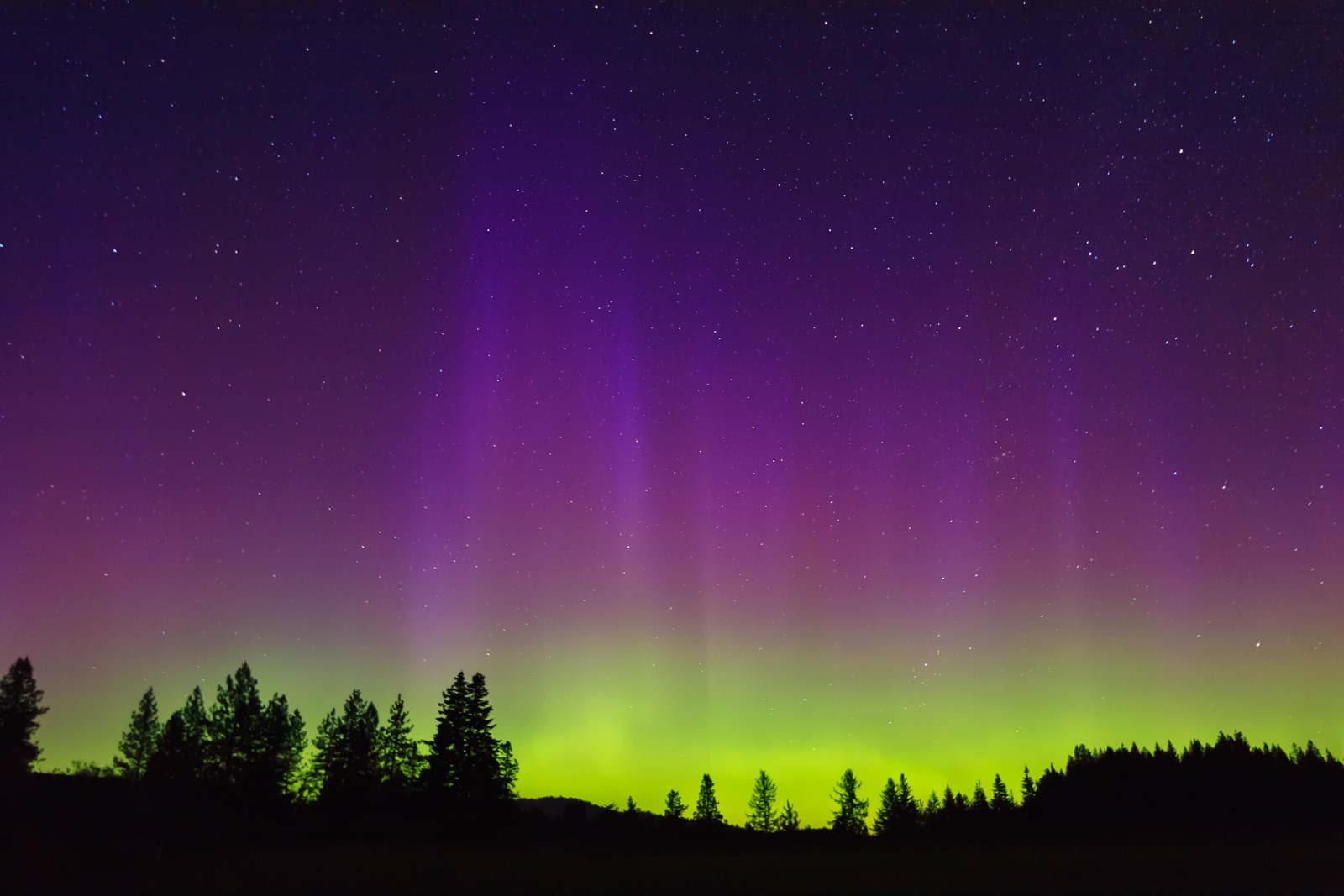
    Once again, the skies lit up with the dancing inferno of the northern lights. The sun has been fairly active the past two months, but this is the first I’ve both been aware of and had a clear sky to see. All of the aurora events I’ve photographed have been special, and each one is different. This one happened to be the strongest storm when the K-index reached 7. It was so bright, I could make out the red band with the naked eye once my vision adjusted to the darkness. The storm peaked here a little after 11:30 pm…

  • 2013: A Year in Photographs

    This year, I have fallen behind in my photography pursuits. It’s in part due to the events in February, and part due to not having the funds or time to get out as much as I’d have liked. I’ve been looking through some stats tracking the number of photos I’ve taken over the past few years, though a better metric is to look at the number of “good” photos that have made it onto my flickr page. Here’s a short breakdown: Year Number of photos 2006 335 2007 310 2008 396 2009 629 2010 341 2011 421 2012 314 2013…

  • |

    Nostalgia

    times square, originally uploaded by Matthew Singer. I’m going to start this post by sharing a few photos I shot on Kodak T-Max black and white film way back in 2001 during my freshman year of college. Film. Back then, my little school of 1600 had a darkroom that the photo club and art department shared. It was in the basement of one of the dorms. When the art department got its brand new building, it got a brand new state-of-the-art darkroom, and the club took complete ownership of the old darkroom. I’m not sure what’s left of the facility…

  • |

    2010, Volume 2

    There’s a new book in my bookstore. I finally got around to completing 2010: A Year of Change, Vol. 2. Volume 1 followed the first half of the year as I finished working in Virginia, got married and prepared to leave the eastern United States. Volume 2 continues the journey, starting with a visit to Idaho in February to visit the school and the area, then the road trip from Maryland to Moscow, and some exploration around my new home as we settled in and started school. Pick up your copy by clicking on the badge below.   2010 The…

  • Fall Foliage

    Foliage, originally uploaded by Matthew Singer. With the sudden drop in temperatures, Fall has officially begun in the northwest. This is the first time I’ve spent fall in a predominantly evergreen forest. While there is color to be found in the west, I suspect that the immediate area won’t be the place to find it. But, as fall rolls in, I provide a tribute to the spectacular display before the forest retires for winter.

  • Palouse Photography: Waiting for the right light

    This post will demonstrate just how fast light can change, especially during sunrise and sunset. These three images, taken in the same location on the same day within a half-hour window, demonstrate just how quickly light can change. Therefore, it is often necessary to scout out locations before setting up your desired image so that you can be ready to capture the scene when the light is perfect. Of course, perfect light is a subjective quality. All three of these images are wonderful, which means all three lighting scenarios are desirable. I spent as much time as I could at…