Fall Foliage

Fall Foliage

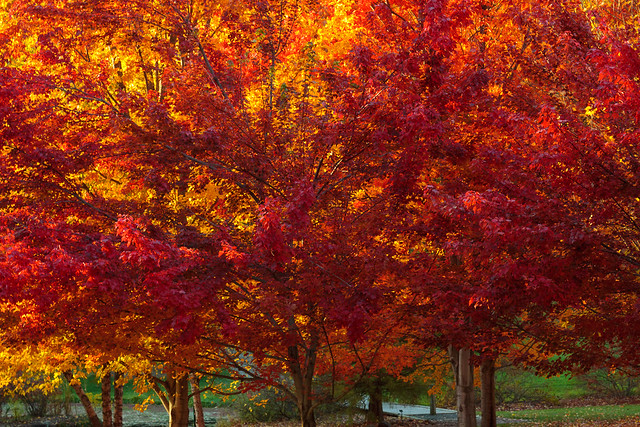
I’ve been spending a lot of time finishing up my dissertation proposal, which is due in a little over a week, and that has kept me from taking time to enjoy the outdoors. We got some considerable rain over the past weekend which lead to some dramatic skies and really clear views on Monday and Tuesday, but I just wasn’t able to take advantage of the nice conditions. I did get out for a little bit yesterday afternoon to check out the fall foliage in the arboretum on campus.

In Idaho, we don’t see very much fall color. There are a few shrubs and trees that turn this time of year, but for the most part, the grasses become even more brown, and most of the deciduous plants skip the color part altogether. The key to great color is a cold and wet climate. We have the cold during the winter, and even the wet in the spring and early summer, but it gets too hot and dry to sustain wild populations of maples, birches, and aspen. What we get are some stands of colorful trees here and there rather than large vasts of colorful forests that carpet the landscapes of Maine, New Hampshire, and Vermont. But there are some places where these trees have been planted and maintained in an artificial setting. The university’s campus is one place to find such color.

You won’t find much color out of the giant Norway Maples on the front lawn, but the Sugar Maples, Black Maples, and Red Maples along with a few other species produce spectacular displays. Some of the best fall trees are located right behind the life science building, but another great stand is found in the arboretum. These trees, native to northeastern North America, are sustained by constant watering and landscape maintenance throughout the dry summer. It’s the best we can do in this part of the country to reproduce the kind of fall seen in northern New England and southern Canada.

The fall colors that we know and love are a result of pigments produced by the plants year round. But during the growing season, they are masked by the abundance of chlorophyll produced. As a result, these pigments aren’t seen during the spring and summer. But as the season comes to and end and temperatures drop, the plant stops producing pigments for photosynthesis. The chlorophylls are the first to break down, and when they do, we are left with the xanthophylls and carotenoids which are yellow and red. These pigments aid the plant in photosynthesis by absorbing wavelengths missed by the chlorophylls. Each species has a different compositional make-up of pigments such that when the chlorophyll breaks down, we see different colors in each plant.

Click on the image above to see some more images from my walk in the arboretum.
Similar Posts

  • Photos

    Mount Adams Summit Originally uploaded by mineral2. Well, I’m finished scanning 5 of 6 rolls from the fall. It sounds pitiful, but there are lots of great shots. Last Fall I shot off 9 rolls between Alabama and North Carolina. In the spring, I topped that with 13 rolls including the hike in Virginia. Add 2 more over the summer and the 6 from the fall and I’m up to 21 for 2006. Actually, I finished off number 22 yesterday, but I probably won’t have a chance to scan that in for a while. Look for a White Mountains gallery…

  • Spring has Sprung

    Spring is officially here on the Palouse, as temperatures soar to almost 80 degrees and graduation season is upon us. The University of Idaho had its commencement yesterday, though I did not attend. This marks the end of my first year in graduate school, and so far it has been a success. But this summer, I’ll be finishing up some projects in the lab and really hammering out ideas for my own disseration. Of course, the summer is not completely for work. I’ll be planning a few backpacking trips and other expeditions to explore the landscape around me. The real…

  • |

    Fourth of July

    For many years, I have spent my Fourth of July basking in the part of America that I enjoy the most: its wild and natural beauty. It started in 2011 when I explored the Hobo Cedar Grove for the first time. Then again in 2013 when I hiked Grandmother Mountain. In 2015, I spent the fourth in the Seven Devils with friends. This year, I returned to Grandmother Mountain for what may be my last visit to one of my favorite peaks in the vicinity of Moscow.

  • |

    The Birds at our Feeder

    We get lots of birds in our trees in the front yard. This could be contributed to the source of food we are supplying to them. The list of winter birds is less than the summer residents. For example, I haven’t seen a bluebird in months, and most of the woodpeckers have left the yard too. And of course, the hummingbirds have gone since they don’t have the proper gear to tolerate the cold. But even with the few remaining species, watching the feeders has been a delight. In Idaho, we have the possibility to see four different kinds of…

  • Small World

    Harvest Moon, originally uploaded by Matthew Singer. Beth, one of the photo club members and employee at the Prichard Art Gallery downtown, mentioned at our last meeting that a student was in town with the current exhibit at the gallery. He didn’t know anyone and was desperate to hang out with people his own age. So we got a group together last night and hung out around the town. I thought the visiting student was an art student, but it turns out he’s actually studying conservation biology and had spent some time working environmental education. And, he’s from Maine. Well…

  • Jerry Johnson

    We’ve gotten a lot of snow this winter. And then it got cold. Like, really cold. Night time lows below zero, and daytime highs hovering around 20.  So the only thing to do with this kind of weather is go swimming. Last year, we took Clara to a developed hot spring near McCall and she loved it. This year we decided to give the undeveloped hot spring a try. Spoiler: She had a blast. Our biggest concern was keeping her warm during the one-mile hike to and from the springs. She did fine in her little blue down suit, but…