Aurora

Aurora

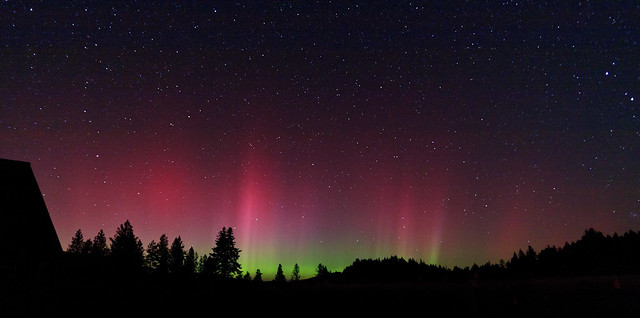
Tonight I had a great surprise and learned a valuable lesson as to why it’s somtimes good to stay up late, even on a school night.

I got the word of an aurora event tonight around 11:30 local time, and this was from people on the east coast. So I thought to myself: I wonder if I can see it here. I went outside and didn’t see any dazzling lights dancing in the sky, so I came back in thinking that either I missed it or I was just in the wrong place to see it.

But then I started thinking: what if the aurora is just too dim for the naked eye to see, but bright enoug for the camera to pick up? I asked my wife how bright the aurora usually is and she said it depended on the circumstances. Some are bright and some are dim.

I went back outside and looked to the north and saw that the sky was somewhat bright… like light pollution. But in that direction, there are no towns to produce light pollution. I got the camera out of the car and set it up on the tripod and snapped a shot. Sure enough, my suspicions were confirmed when the hazy glow turned out to be green and pink. My other suspicion came from a ray of light shining up from behind the trees, almost as if someone had a spotlight. Then the beam disappeared. It would reappear in different places throughout the night and the sky would vary its intensity.

I saw a freaking Aurora.

Similar Posts

  • |

    Chickadees

    For Christmas, I bought Erin a new bird feeder to replace one that had been broken earlier in the summer. A few weeks ago, we finally got some seed and put it outside, but this was in the middle of a cold snap where daytime highs remained in the low 20’s, and the nighttime lows, well, we just won’t go there. For about a week, the feeder hung with no activity. Then, as the cold began to lift, there was a single chickadee in the lilac tree. It must have spread the news because a few days later, the feeder…

  • 2013: A Year in Photographs

    This year, I have fallen behind in my photography pursuits. It’s in part due to the events in February, and part due to not having the funds or time to get out as much as I’d have liked. I’ve been looking through some stats tracking the number of photos I’ve taken over the past few years, though a better metric is to look at the number of “good” photos that have made it onto my flickr page. Here’s a short breakdown: Year Number of photos 2006 335 2007 310 2008 396 2009 629 2010 341 2011 421 2012 314 2013…

  • Fall Foliage

    Foliage, originally uploaded by Matthew Singer. With the sudden drop in temperatures, Fall has officially begun in the northwest. This is the first time I’ve spent fall in a predominantly evergreen forest. While there is color to be found in the west, I suspect that the immediate area won’t be the place to find it. But, as fall rolls in, I provide a tribute to the spectacular display before the forest retires for winter.

  • |

    2010, Volume 2

    There’s a new book in my bookstore. I finally got around to completing 2010: A Year of Change, Vol. 2. Volume 1 followed the first half of the year as I finished working in Virginia, got married and prepared to leave the eastern United States. Volume 2 continues the journey, starting with a visit to Idaho in February to visit the school and the area, then the road trip from Maryland to Moscow, and some exploration around my new home as we settled in and started school. Pick up your copy by clicking on the badge below.   2010 The…

  • Steptoe Butte and the Palouse

    When I moved to the Palouse, I didn’t realize just how photogenic the landscape was. Then I saw ads for the Palouse in Popular Photography. It turns out, people will pay good money to come and photograph the region, and here I am living there not taking advantage of my home turf. I’ve only been on Steptoe Butte once before, and it was in the winter with not much snow on the ground. So I was quite glad when Simon came back to visit and suggested we go out and shoot the Palouse. We hit Steptoe Butte at the right time…

  • |

    Aurora

      This story begins Friday night when I learned that a large coronal mass ejection (CME) sent a burst of solar radiation from the sun headed toward Earth. It was predicted to intercept our atmosphere on the evening of the 8th, producing auroral activity in the high latitudes. Given the size of this solar storm, as described by spaceweather.com, I was a bit suspicious that the auroras migh be big enough to see all the way down here in northern Idaho. So, I kept a watch looking for evidence of such activity. On the evening of the 8th, I checked…