Month: July 2012

  • Lookout Mountain

    View North

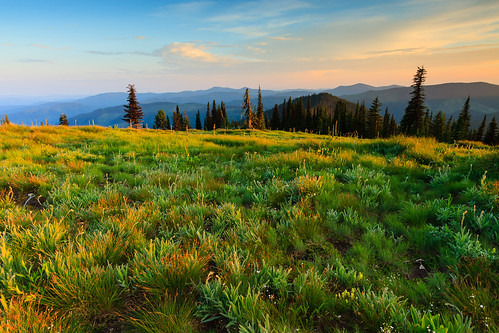
    Everytime I’m up on Grandmother Mountain, I look to the east and see the bald dome of Lookout Mountain rising over the Marble Creek drainage and I long to stand on top and look down from the other side. Finally, with my parents and sister visiting, I decided this would be the perfect opportunity to try out this trail.

    There are several mountains in northern Idaho named Lookout. This is not the ski area on the Idaho-Montana border off of I-90. This is not the peak in the Selkirks north of Sandpoint of the same name. This is in the St. Joe National Forest, accessed from FS-301, the same road that leads to Freezeout Saddle and the Grandmother Mountain trail outside of Clarkia.

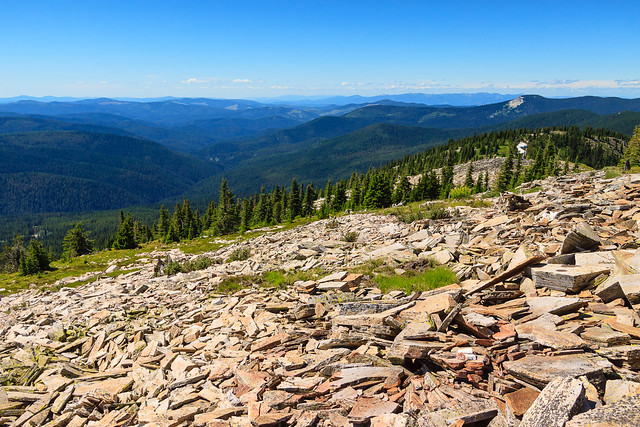
    Lookout Mountain is unique for this area because its summit is completely bald, offering spectacular views in 360 degrees. The summit stands at 6789 feet above sea level and overlooks Lost Lake, the nearest glacial tarn of considerable size to the Moscow Area. This trail is absolutely beautiful and probably seldom used compared to the neighboring Grandmother Mountain trail. The trailhead is only 7 miles farther down the road, but due to the rough road conditions, it took an extra hour of driving to get there. Despite its apparent remoteness, the trail and trailhead are in great condition. The trailhead features several developed campsites with picnic tables and fire rings along with a well-maintained privy. There are also two other small campgrounds nearby. Next time I hike this trail, I may have to spend the night.

    From the trailhead at Orphan Saddle, it’s a 4-mile walk to the summit of Lookout Mountain. The trip isn’t very difficult, though you’ll begin your journey with a 600 foot ascent in just under a mile. By the time you start getting tired, you reach the ridge at 6500 feet and the journey becomes a relaxing meander through a mixture of hemlock forest and grassy field. The next two miles are gentle, holding elevation until the Widow Peak trial splits off, and then gently descending into the saddle above Lost Lake. The last mile is a 700 foot ascent to the summit, and though it may seem steep, you’re on the spine of the ridge with views that get better with every step you take. Take as much time as you need and eventually, you’ll find you can’t go any higher.

    The return journey isn’t too bad. The descent on the way out was gradual and not very noticeable, but you may notice the uphill on the return. However, it’s still gentle compared to the two ascents (now descents) on the way out. In short, this may have become my new favorite local hike. Unfortunately, it is such a pain in the butt to get to that I’ll probably still stick to Grandmother Mountain as my go-to escape to higher elevations.

    Map and elevation statistics

    More Photos

  • Publications

    Walking Among Giants

    I don’t usually like to gloat about my accomplishments, but sometimes a little self promotion doesn’t hurt. I’ll start with the announcement of my first publication, which officially rolled off the presses last month. Last year, our lab was contacted to write a book chapter in a methods and protocol book on assessing anxiety behaviors in Zebrafish. So Barrie, Maia, Mary, and I set out to publish our behaviortyping protocol for assessing observer preference, depth preference, and feeding latency for high-throughput experiments.

    Robison, BD, MJ Benner, ML Singer, ME Oswald. A High Throughput and Inexpensive Assay for Anxiety Related Behaviors in the Zebrafish, Based on Place Preference and Latency to Feed. in Zebrafish Protocols for Neurobehavioral Research. A.V. Kalueff and A.M. Stewart (editors), Humana Press, NY, 2012.

    So, I officially have my name on a publication. But it gets better. If you follow the link, there is an image of the front cover of the book. That’s my photograph of the Zebrafish mirror biting test. How cool is that?

    A few months ago, I was contacted by the editor of American Forests to use one of my images from the Hobo Cedar Grove in their summer issue of the magazine, American Forests. So after having a look at the organization and deciding that I support their goals and mission, I gave them permission to publish my image. I received my copy of the magazine to day to find my image was used as a two-page spread feature for one of the articles. The online issue features the photo, but the print version looks nicer.

  • Wallowas

    Looking across the Lostine River Valley

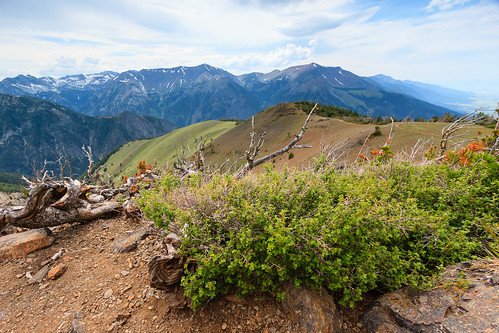
    The final chapter in the visit of the in-laws consits of a visit to one of my favorite mountain ranges. There are many spectacular mountain ranges in the country, but I happen to have a fondness for the Wallowas in northeastern Oregon. Perhaps its because they’re the closest mountains of their kind, or because they truely are a spectacular gem. I’ve always wanted to bring people to the Wallowas, but there aren’t really a whole lot of day hiking opportunities. All of the lakes and the peaks are just far enough away that the trips would be better done as an overnight trip. There is one exception. Mt. Howard is accessible by a gondola that rises 3700 feet into the mountains. And so when I mentioned that this might be a good place to come on their next visit, the plans quickly changed to seeing these mountains before they left for Pennsylvania.

    We were originally going to go camping along the North Fork of the Clearwater to go fishing and explore the bit of inland rainforest at the base of the Mallard-Larkins area. We were going to leave Sunday and come back Monday, but Sunday morning, nobody was motivated to pack. Steve and I were still recovering from our backpacking trip, which although was short and sweet, was also tiring. Once noon had passed and we still hadn’t packed, we decided that Sunday would be a more relaxing day with a trip to Elk River and Freezeout Saddle (see previous post). So we moved the camping to leave Monday and return Tuesday. Those days had better weather reports anyway. However, once we were up at 6000 feet, Retta had decided she wanted more high elevation experience, and when she heard that we could get her to 8000 feet without any hiking effort, she had made up her mind.

    Of course, I didn’t really mind either. I love the Wallowas and any chance to bring new people there is a chance for me to see these wonderful mountains. I also love the drive out. On this trip, they got to experience the Lewiston Grade and the deep canyon of Rattlesnake Grade which also blew their minds. It’s one of the most scenic drives we can take in this area, though doing it twice in one day does wear you out.

    So there we were, riding the Wallowa Lake Tramway. Retta did well with her height issues and once we were on top, it was nothing but sheer enjoyment. 8000 feet can take your breath away, litterally. The air is thinner so less oxygen gets to your lungs per breath, and while most people don’t notice it until exceeding 10,000 feet, first-timers will feel the effects on Mt. howard. But no worries. The paths atop the tramway are very easy and short, only 2.5 miles in total, so there is no rush.

    Now that I’ve finally been up the tramway, I don’t really feel the need to do it again, but I think I may bring my parents up there next week with the intent of following the ridge to East Peak above 9000 feet for better views of the Wallowas and Hells Canyon. And then I’ll be back once more for our 3rd annual backpacking trip in the Eagle Cap Wilderness. I never get tired of this place.

  • Return to Freezeout

    Sunset on Freezeout Ridge

    Any time someone visits us, their stay would not be complete without a trip to Elk River and Freezeout Saddle. We were limited in our acitivites because one of our guests were not fit for any major hiking, but luckily, we have options for that. So Sunday, we took an easy morning and headed out mid-afternoon for some local adventure. In Elk River, we stopped at the general store for huckleberry ice cream and then headed out to see the giant cedar, which always amazes anyone who has never seen big trees.*

    The allure of Freezeout Saddle is that it’s the closest place to exceed 6000 feet, and it’s also the closest place to find alpine flora. Retta had never been this high up before, so this was certainly a novelty. We also found out the hard way that she has a fear of heights. Since we weren’t going to hike to Grandmother Mountain, we decided to drive past the trailhead out on Freezeout Ridge. Last year at this time, the road was blocked by a patch of snow after leaving the open slopes and reentering the forest. This year it was wide open. Unfortunately, the road is quite bumpy with a steep drop on one side, so I can see how anyone with an issue with heights might be nervous.

    Freezeout Ridge is nice. There used to be a fire lookout, but the tower is now gone. The area where it stood is still bald of trees and provides a 360-degree view of the clearwater mountains. We spent some time enjoying the cool air and the awesome views and then I realized that we might as well just stay up there for the sun set, which looked like it may turn the sky a fiery pink. Unfortunately, there were clouds on the horizon that blocked the light, but it was a nice sunset anyway. We headed down in the dark hoping to see an Elk, but no such luck this time.

  • Backpacking: Seven Devils’ Lower Cannon Lake

    Sunrise at Lower Cannon Lake

    My father-in-law and his wife have been visiting us since last Wednesday. Before coming out, he had asked if we could go on a little male bonding trip into the backcountry for a night. So, I set about looking for a short and easy hike to a spectacular place. I figured he had probably never spent the night under the rocky peaks next to a glacial tarn, and the high lakes are also one of my favorite places to spend a night, but most of the lakes around here are either fairly strenuous hikes, long hikes, or take nearly all day to get to the trailhead. Stevens lake originally came to mind, but Erin thought that might be too steep, despite the short 2.5 mile hike in. So I kept looking around and found Loon Lake out of McCall, which isn’t really a high mountain tarn but a morain lake at the base of a glacially carved valley.

    I was all set to go to McCall when the heat wave hit Idaho. It was over 90-degrees in Moscow, and not much cooler in McCall. So I thought about some place that was a bit higher up: the Seven Devils. The loop trail around the seven devils is on the easy side of moderate, and Cannon Lake is only 4 miles in from the trailhead. At 7000 feet, the temperatures were much cooler than anywhere else. Then I checked the weather and noticed a good chance of rain in the McCall area, but less of a chance at the Seven Devils.

    Garden Paradise
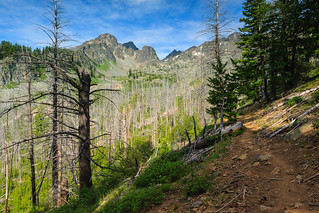
    The trail to Cannon Lakes is short and sweet. It’s not difficult at all except for a few downed trees to navigate around. This is a beautiful walk around the east side of the Devils, descending through a lush forest of Mountain Hemlock and then traversing the mountainside through the burned forest, now on its way to recovery, but for now lined with lupine, paintbrush, and a variety of other wildflowers. The trail crosses a few creeks and at about 3 miles, meets up with the Cannon Lakes trail. From there, you ascend back up to 7000 feet over the next mile, traversing through beautiful flower-laden alpine meadows. The toughest part of the hike was the return trip, where we had to ascend about 1000 feet over the course of 1.5 miles back to the trailhead.

    Seven Devils Loop approaching Cannon Lakes
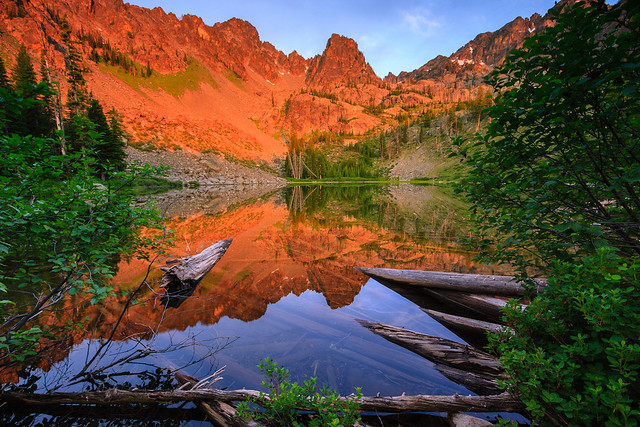
    Cannon Lake sits in a basin between She Devil and Tower of Babel, both of which are visible from the trail, but disappear behind some closer formations as you approach the lake. The peaks tower over 2000 feet and really instill a sense of awe. Because we were on the west side of the range, the sunset was fairly lackluster, but sunrise was spectacular. The high peaks receive the first light of the day and are quickly bathed in the pink alpenglow of the sun emerging from the horizon. Normally, I’d be up to witness the first light on the peaks, but on this trip, I slept in, woken up only by my father-in-law who beat me to the morning view. Luckily, I rushed out of the tent just in time to catch the whole face bathed in pink before the color completely faded.

    Friday’s hike in was on a very hazy and muggy day. The air was cooler up on the mountain, but the view was almost nonexistent. You could barely make out the mountain peaks across the Salmon River canyon. Despite the threat of thunderstorms, we had a clear night with blue skies and sunshine the next morning. The haze had thinned out on Saturday and the temperatures dropped a bit never exceeding 70. It was the perfect hiking condition.

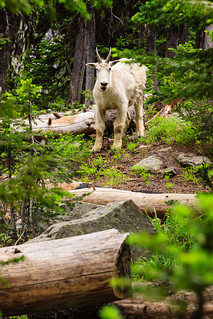
    Mountain Goat
    When we returned to the car, I decided to show him the campground, and it’s a good thing we did. A mountain goat was hanging around one of the campsites. I then took him up to the Heaven’s Gate Lookout to get him over 8000 feet and get a view of Hells Canyon. Our stay at the tower was cut short by an approaching thunder storm that we watched approch over the high peaks. I’d say we timed this trip perfectly. The rain hit as we started our descent back into Riggins.

    There’s one precaution to take when hiking into the high country this time of year. I had underestimated the course of mosquito season, and it seems we had hit the motherload. I also made the mistake of dismissing the need for bug spray. I generally don’t use it because I hate putting chemicals on me and introducing them into the environment. But given how bad the mosquitoes were, I’m willing to reconsider.

  • Aurora, part II

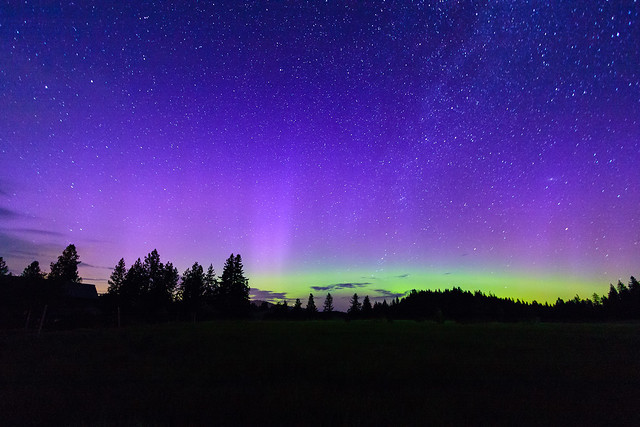
    Aurora

    Well, I made my last post a bit too soon. After spending the evening on Freezeout Ridge (story and photos to come soon), Erin reminded us that the aurora might still be occuring and that we could possibly see it tonight. Clarkia isn’t the best place to test this hypothesis because its surrounded by tall mountains in all directions, so as we passed through Bovill, I noticed a glow on the northern horizon. At this point, it was only 10:00, still early enough that the glow could be residual light from the sun. I pulled the car over and set up the camera for a test shot. Sure enough, there was a green and pink glow in the sky, but there was also some light left over from the sunset. So, we continued on.

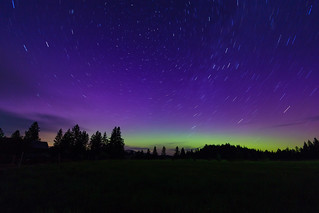
    When we got home, the sky had darkened and the glow to the north was brighter than ever, with some streaks rising high into the sky. So we unloaded the car from the day’s excursion and I set up the camera in the field and produced the image above. Then I thought about trying to capture star trails, so I dialed the ISO down to 100 and left the shutter open for 10 minutes, being too impatient to wait any longer.

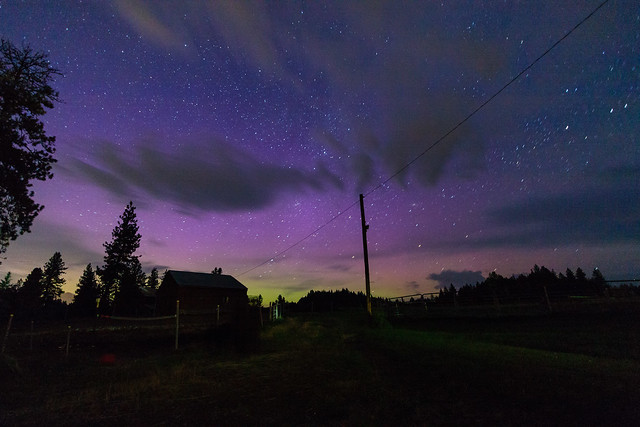
    Aurora

    Of course, no Aurora night would be complete without a storm blowing in to cut viewing time short.

  • Aurora

    Aurora Borealis

    We got alerts that a solar flare could cause an aurora that would be visible into the middle states. So, last night, I checked the sky and luckily it was clear to the north. I saw a faint glow on the horizon and set up the camera. Sure enough, there was an aurora. The excitement didn’t last too long. I wanted to view this one from Steptoe Butte, one of the best places around for viewing auroral activity. So, we got in the car and started driving west. Unfortunately, the sky was overcast over much of the Palouse, and by the time we got home, the clouds had moved in overhead. Figures that most of the time we get big auroral activity that can be seen in Idaho, we also get storms the same night.

  • Freezeout

    FS-257

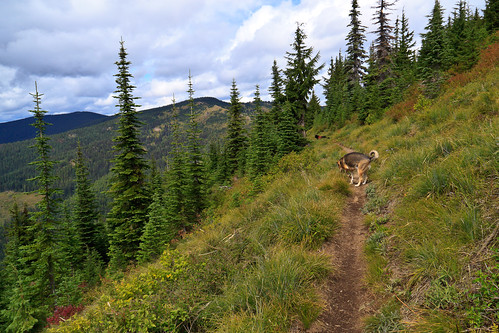
    The heatwave has hit the northwest. Today’s temperatures on the Palouse rose into the high 90’s, and tomorrow it may break 100. I wanted to hike so I can get in shape for backpacking next month, so I thought I’d take the dogs up to Freezeout Saddle and hike to Grandmother Mountain. But when I got up there, it was also hot and somewhat muggy, so we didn’t make it very far. I brought the camera, but got no pictures on this trip. The summer wildflowers are starting to bloom: beargrass was in its early stages, and the lupine had buds, but no open flowers yet. Plox was open, creating a colorful ground cover in places. The glacier lilies had already gone to seed. But overall, we should see the full color in the next week or two. Already, there is less snow on the trail than there was when I brought my parents up at the end of July last year. This holds good promise that the high country is now open for business.

    The best part about today’s excursion was the wildlife sightings, nearly all of them from the car as we were headed down. The only wildlife I spotted from the trail was a fesh pile of bear scat. But on the way down, I came across a very colorful Western Tanager, an elk on the road, a family of skunks (mom and 3 juveniles, I believe), and what I believe to be a wolf. As I came to the bottom of the incine where the road meets the creek, I saw a large dog standing in the intersection. It looked like a husky, definitely bigger than a coyote, but I was also far away so it’s hard to tell. It ran off, and I kept driving, but then I saw it again in the road, running away. I tried to catch up to it to get a better look, but it darted off to the side and then I lost it. I’m not absolutely positive it was a wolf. Coyotes are much more common and more likely, but this was bigger than any coyote I’ve seen, though smaller than a wolf should be. It was more grey and white, rather than the brownish-grey that the coyotes are. It could be a feral dog. Either way, it surely wasn’t tame as it spooked at the first sight of the car. So, it could be a wolf, but I’m not positive, and I hesitate to call it as such. It’s exciting, nonetheless.

  • Fireworks in the Mountains

    Celebrating Independence

    A garden update from the last post: I’m happy to announce that the lettuce that the chickens ate down to the soil is growing back quite nicely and will be ready for consumption within a few days.

    And now on to the main post:

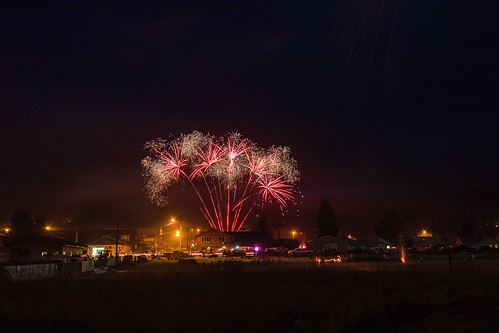
    Elk River hosts an annual Independence Day celebration they call “Fireworks in the Mountains,” but they don’t necessarily hold it on the 4th of July, but on the weekend before or after if the 4th happens to be mid-week. The event attracts a lot of people and the general store stays open late to sell its famous huckleberry ice cream. Of course, the local bar wasn’t doing to bad on business either.

    The actual fireworks show was small, but the allure is that the loud bang can be heard reverberating off of the mountains all the way down the upper basin and back. However, the hoards of people visiting and camping had brought their own fireworks, and many bought some pretty big and expensive pieces, the kind that are illegal in most states. These added supplemental entertainment while waiting for the real show to begin.

  • Gardening

    I can’t believe it’s July already. Time is flying by this summer. June has been a mixture of hot and dry with cold and rainy, and that has been good for my garden. Last year, I built two raised beds, each 8′ x 4′, but I only got one bed filled with dirt. It yielded some nice tomato plants that I had started from seed, until the goat got in and ate them down. This year, I got the second bed filled with dirt and built two more 8′ x 2′ beds which I filled with strawberry plants. The two larger boxes contain tomatoes, peppers, lettuce, cilantro, and basil and some marigolds to help keep bugs away. The photo above was from early last week, and everything is doing well. The lettuce had been looking good, so this weekend, we actually picked a few leaves and had a very delicious home-grown salad. And then, for some reason, that got the chickens interested as well. The next day, we found the chickens eating lettuce out of the long boxes also full of lettuce on the porch. That’s when I ran outside to discover they had gotten to the garden supply first. All that gorgeous lettuce was gone in an instant.

    I’m not sure what set them off. They had been in and around the garden area the entire season and not touched a plant. I wonder if by picking off leaves, the lettuce plants emitted a chemical that the chickens picked up on and finally noticed that the lettuce was there. I’ve since taken precautions to exclude the chickens from the fenced-in garden. We got some chicken wire and attached it to the gate, but had discovered that the chickens were still getting in. It turns out that the one side of the fence didn’t actually reach the ground, and the birds were able to walk right under it. So, I blocked that off and so far the chickens haven’t been back to bother the crops. I’m hoping that enough plant material is left for new leaves to start growing, but just in case, I planted some more seeds, though they won’t be ready for consumption for another two months. But by that time, the tomatoes and peppers should be ready and we can have a fully home-grown salad.

    On the flower front, one of my natives that I bought and planted last summer had survived, and so the blanketflower is now in bloom. I also noticed a couple of sunflower plants growing. I hadn’t planted any this year, so they must have come from the bird feeder. One was starting to get pretty big when Mower (the goat) decided it was a lovely snack. Mow also loves to eat roses, and I noticed a few blooms on our rose bush had gone missing, so the goat is now grounded from the free snack buffet until the flower season comes to an end. She’s already eaten most of the flower buds from the day lilies, but a few remain in the back of the house.

    Now that we had the mud/horse manure compost scraped into a big pile, it’s much easier to load into the cart. I’ll work on adding more raised beds to the vegetable garden, but we can also add some nice compost to the flower gardens this fall to help control weeds and feed the plants. We’re also going to rip out the creeping cedar bush that seems to be taking over and plant the area with flowers to attract hummingbirds and butterflies. I’d like to do mostly native wildflowers, but I’ll settle for a few cultivated varieties.